

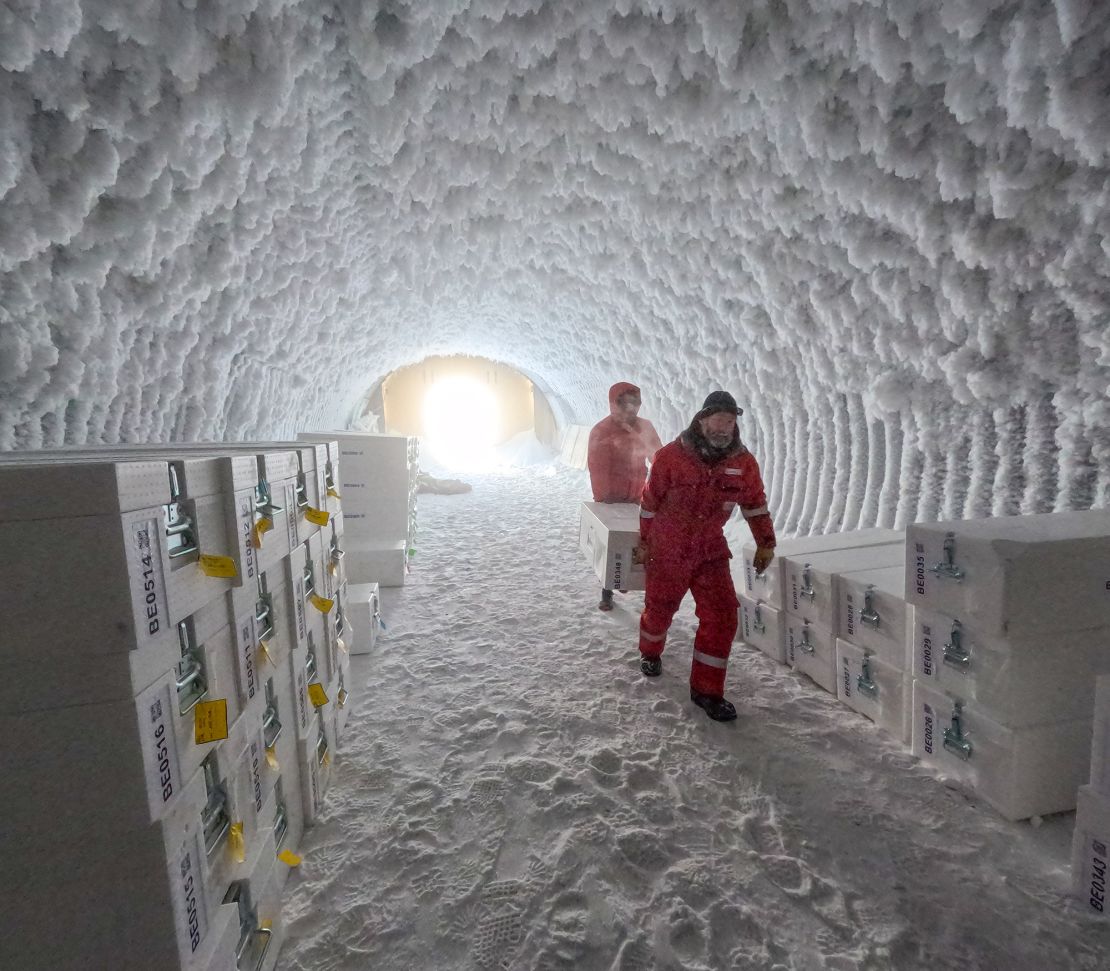

In a groundbreaking effort to protect the planet’s vanishing climate history, scientists have successfully extracted ancient ice cores from the European Alps and transported them thousands of kilometres to Antarctica, where they are now preserved in a specially constructed snow cave at the Concordia research station.
The frozen archive, maintained at a constant temperature of minus 52 degrees Celsius, is designed to safeguard the fragile ice samples for centuries, allowing future scientists to study Earth’s climate evolution long after many glaciers have disappeared.
As glaciers across the world melt at an accelerating pace due to global warming, researchers warn that invaluable climate records trapped in ice are at risk of being lost forever. The project seeks to preserve this irreplaceable scientific heritage and provide future generations with the tools to better understand how Earth’s climate has changed over millennia.
“To safeguard what would be otherwise irreversibly lost is an endeavour for humanity,” said Thomas Stocker, a Swiss climate scientist and chair of the Ice Memory Foundation, which led the initiative.
A Decade-Long Mission with Global Challenges
The ambitious project took nearly ten years to plan and execute, involving not only extreme logistical hurdles but also unprecedented diplomatic coordination. Transporting ice cores from Europe’s highest peaks to one of the coldest and most remote places on Earth required international cooperation, meticulous planning and cutting-edge preservation techniques.
The sanctuary itself is not a traditional storage facility but a vast underground snow cave, measuring 35 metres in length and five metres in height and width. It was excavated roughly 10 metres beneath the surface of compact Antarctic snow, where freezing temperatures remain naturally stable year-round.
Under clear yet bitterly cold conditions at Concordia — located around 1,000 kilometres (620 miles) from the Antarctic coast — scientists marked the milestone by cutting a blue ribbon as the final insulated boxes containing ice cores from Mont Blanc and Grand Combin were carefully placed inside the frozen vault.
Preserving Ice from Around the World
In the coming decades, researchers plan to expand the archive by adding ice cores from endangered glaciers in mountain regions such as the Andes, the Himalayas and Tajikistan. In Tajikistan, AFP journalists witnessed the extraction of a 105-metre-long ice core in September, underscoring the scale and urgency of the effort.
These samples will remain untouched until future scientific advancements allow researchers to extract even more detailed information from them.
Unlocking the Secrets Trapped in Ice
Ice cores are among the most valuable natural archives on Earth. They contain microscopic traces of ancient atmospheres, revealing information about past temperatures, precipitation patterns, air composition and volcanic eruptions stretching back tens of thousands of years.
However, these delicate records are rapidly disappearing. Scientists estimate that thousands of glaciers could vanish within decades if current warming trends continue.
“We are in a race against time to rescue this heritage before it will vanish forever,” said Carlo Barbante, an Italian climate scientist and vice-chair of the Ice Memory Foundation.
Researchers believe the true scientific value of preserved ice will only grow as new technologies emerge, enabling future scientists to uncover insights that are impossible to detect today.
A Neutral Sanctuary Dedicated to Humanity
The ice archive is housed at a French-Italian research station governed by the Antarctic Treaty, which designates the continent as a zone of peaceful scientific cooperation. This location was deliberately chosen to ensure political neutrality and equal access for researchers worldwide.
According to Anne-Catherine Ohlmann, director of the Ice Memory Foundation, establishing a clear governance framework is essential to ensure the archive remains dedicated solely to scientific progress.
The long-term goal is to preserve these priceless ice records for future generations, ensuring they are studied based on scientific merit and used for the benefit of all humanity.
As glaciers continue to retreat, the frozen vault beneath Antarctica’s snow stands as a last refuge for Earth’s disappearing climate memory — a legacy preserved not just for today’s scientists, but for centuries to come.