

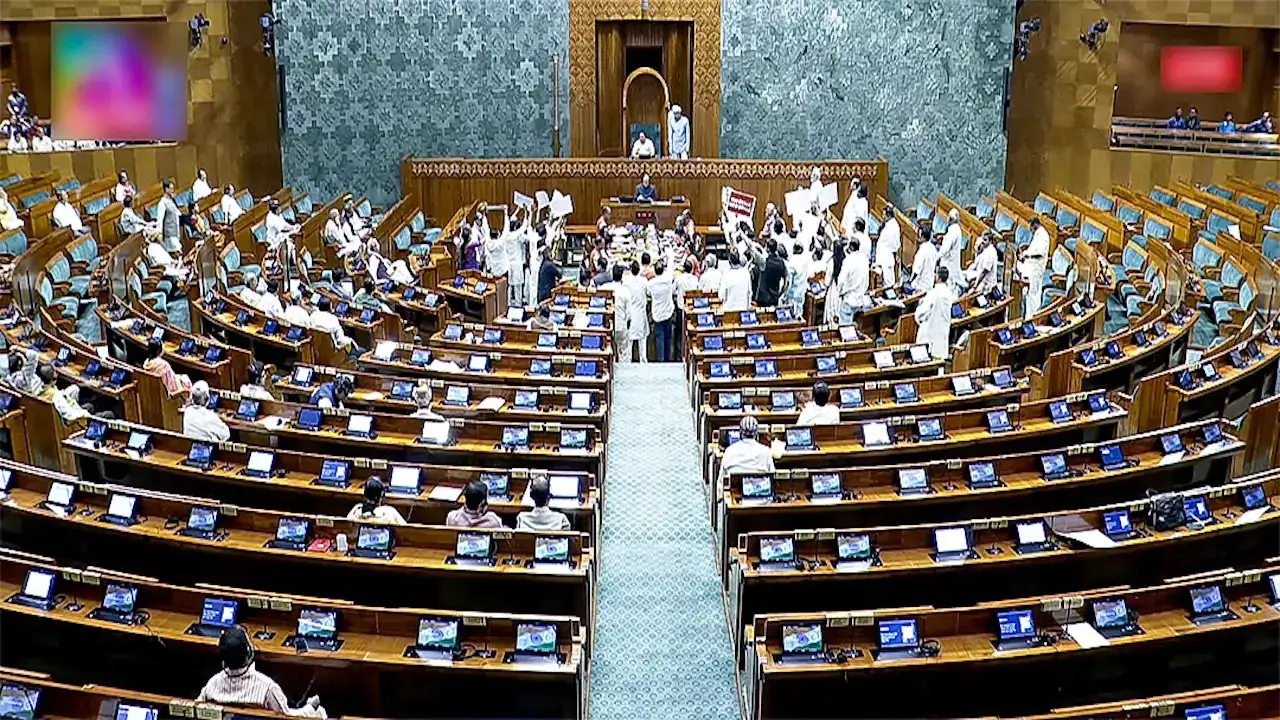

On Wednesday, the Lok Sabha was thrown into disarray when Union Home Minister Amit Shah submitted three controversial measures that would make it permissible to fire elected officials who are arrested and remanded in custody on serious criminal accusations. Opposition lawmakers ripped up copies of the bills and flung the paper balls at Mr. Shah while he was speaking to the House in a dramatic show of anger.
After the controversy in Parliament, Mr. Shah justified the government’s decision to pass the bills, saying that they were necessary because of a new political reality in which “governments are being run from jail.” This was a blatant jab at Delhi’s Aam Aadmi Party administration and its former Chief Minister, Arvind Kejriwal. He was arrested in a case about excise policy but stayed in office for six months after that. “The Constitution doesn’t make it clear,” Mr. Shah said, adding that this kind of thing is “unjust to people’s expectations.”
The three bills that were put on the table were:
The Constitution (One Hundred and Thirtieth Amendment) Bill, 2025: This bill wants to change Articles 75 and 164 of the Constitution so that the Prime Minister and state Chief Ministers can be removed if they are arrested and held for 30 days for a crime that carries a jail sentence of five years or more.
The Government of Union Territories (Amendment) Bill, 2025 wants to change the current law so that it gives Union Territories the same way to remove their Chief Ministers and ministers.
The Jammu and Kashmir Reorganization (Amendment) Bill, 2025: This bill makes it legal to fire the Chief Minister or a minister in Jammu and Kashmir in the same situations.
The Opposition has strongly opposed the laws, saying that they are against the Constitution and a way for the federal government to weaken state governments that are not in its favor. Abhishek Banerjee, the leader of the Trinamool Congress, said, “This Bill is meant to silence the Opposition parties that are asking questions on behalf of the people.” Kalyan Banerjee of Trinamool branded the measure “unconstitutional,” saying that central agencies like the Enforcement Directorate and CBI routinely file “fake cases” with a very low chance of conviction.
Manish Tewari, a member of Congress, said that the measure is “destructive of the basic structure of the Constitution” and “violates Article 21, which guarantees due process of law.” He added that it goes against the basic idea of “innocent until proven guilty” because it lets someone be removed just because they were arrested and held, not because they were convicted.
The legislation have also brought to light a long-standing legal gray area. Ministers, MPs, and MLAs don’t have to resign until they are found guilty under current rules. This is different from other government workers, who are put on leave right away when they are arrested. The Supreme Court had already said that Arvind Kejriwal did not have to step down, saying that it was up to the elected leader to decide. This left the constitutional stance open to interpretation.
Even though there were a lot of protests, Union Home Minister Amit Shah put forward a resolution to send the three measures to a Joint Parliamentary Committee (JPC) for extra discussion. This could let for more in-depth examination and debate before the final vote.