

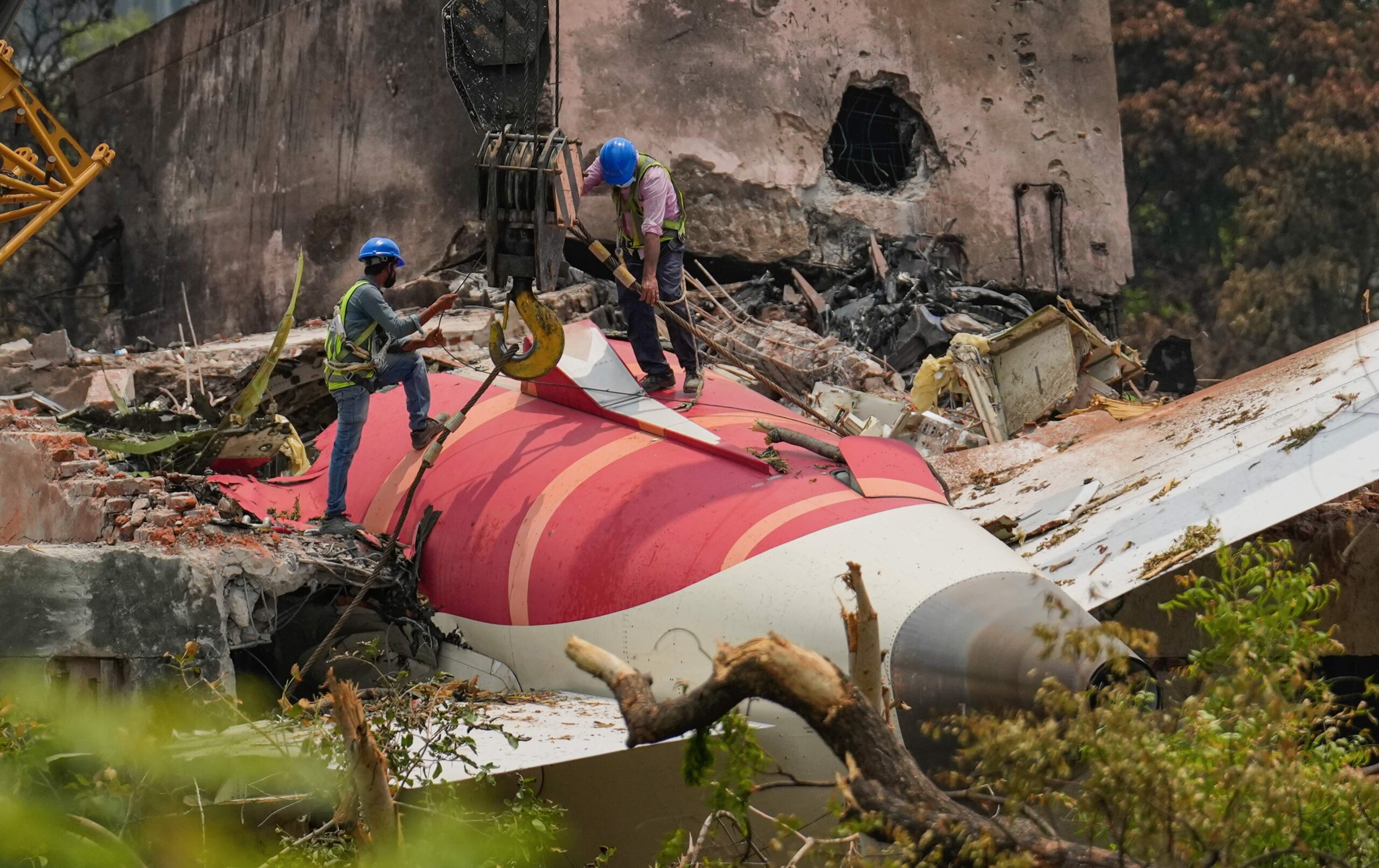

New Delhi [India], July 12: A preliminary investigation into the tragic crash of Air India flight AI171 has revealed a startling exchange between the pilots in the final moments before the aircraft lost power. According to the cockpit voice recording, one pilot questioned the other about cutting off fuel supply to the engines, to which the second pilot denied doing so.
The aircraft, a Boeing 787-8 Dreamliner, crashed shortly after takeoff from Ahmedabad’s Sardar Vallabhbhai Patel International Airport on June 12, killing 241 of the 242 people on board. Former Gujarat Chief Minister Vijay Rupani was among the victims, making this one of India’s most devastating air disasters in recent years.
The preliminary report notes that both engines shut down within a second of each other. “The aircraft reached a peak airspeed of 180 knots at 08:08:42 UTC. Immediately after, both Engine 1 and Engine 2 fuel cutoff switches moved from ‘RUN’ to ‘CUTOFF’—triggering engine shutdown,” the report states.
CCTV footage confirmed the deployment of the Ram Air Turbine (RAT), indicating total power loss shortly after liftoff. The aircraft failed to gain altitude and crashed near the airport perimeter, narrowly missing dense civilian areas.
No evidence of bird strikes or external damage has been found. However, the precise cause of the fuel cutoff remains under investigation. Analysis of data from the Enhanced Airborne Flight Recorder (EAFR) is ongoing.
The report also revisited a 2018 FAA safety bulletin that warned about a potential flaw in Boeing’s fuel control switch locking mechanism. While the issue was noted across several Boeing models, including the B787-8, it was not deemed serious enough to mandate corrective action. Air India did not conduct the recommended inspections, as the FAA’s advisory was not binding.
Records show that the aircraft’s throttle control module was replaced in both 2019 and 2023, but not due to fuel switch defects. No relevant issues had been logged for the switch since 2023.
Currently, no safety recommendations have been issued for other Boeing 787-8 aircraft or GE GEnx-1B engines. Investigators continue to collect evidence and consult with stakeholders to determine whether a design flaw, human error, or system failure caused the tragedy.