

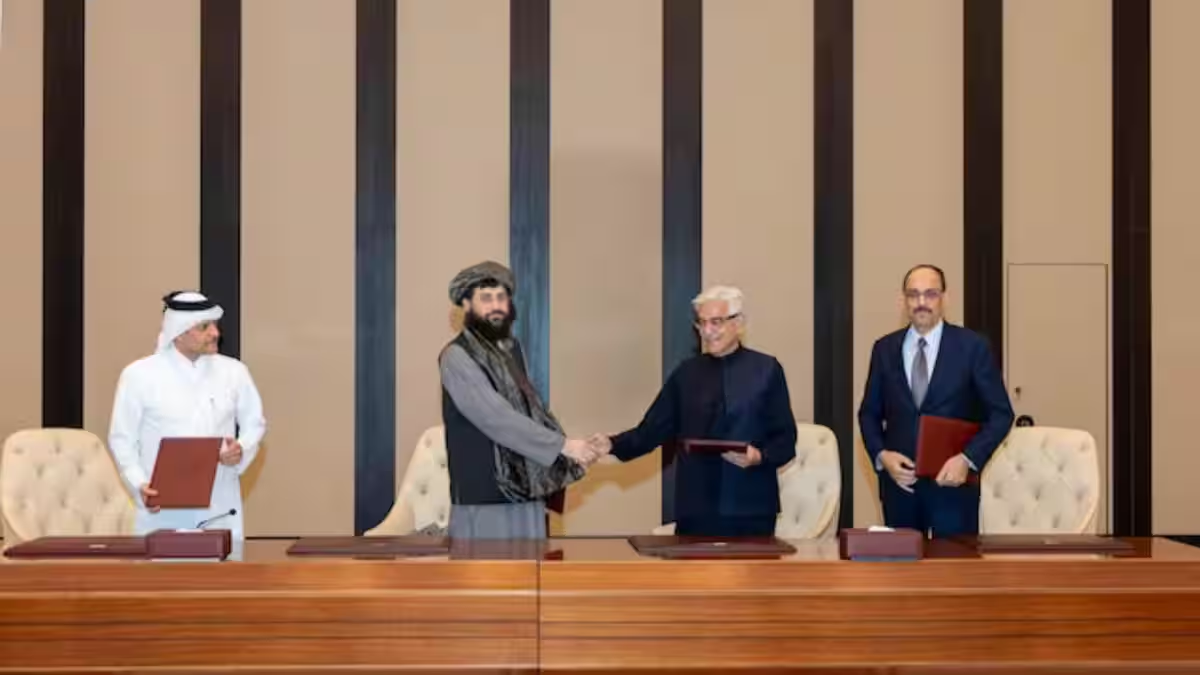

The final round of peace negotiations between Afghanistan and Pakistan in Istanbul has ended without a breakthrough, leading to an immediate escalation of rhetoric from both South Asian neighbours. The Taliban government in Kabul on Saturday placed the blame for the breakdown squarely on Islamabad, claiming its demands were “unreasonable.”
Amid the failure of multiple negotiation rounds to resolve deadly border skirmishes, the Afghan government asserted its “right to defend itself” should the current face-off descend into a full-scale war.
Afghanistan Cites ‘Unreasonable’ Demands
Afghan government spokesperson Zabiullah Mujahid was quoted by news agency AP as blaming Pakistan for the failure of the talks, which were mediated by Turkey and Qatar. Mujahid stated that Pakistan’s “unreasonable demands” had “stagnated the peace process.”
While emphasizing that war was not the preferred choice, Mujahid issued a stark warning: “If war breaks out, we have the right to defend ourselves.” He reiterated the Afghan government’s prior commitment: “Afghanistan will not allow anyone to use its territory against another country, nor permit actions that undermine its sovereignty or security.”
Pakistan’s War Warning and Ceasefire Ultimatum
The failure of the talks follows a pre-negotiation warning from Pakistan’s Defence Minister, Khawaja Asif, who had told Geo News in an interview that “If talks fail, only war will happen.”
On Saturday, Asif reportedly confirmed the talks were “over,” adding a sharp condition to the ongoing truce: the ceasefire would hold only if there were no further violations from the Afghan side.
Echoing the commitment to national security, Pakistan’s Information Minister Attaullah Tarar assured citizens that while Pakistan values peace and stability, it would take “necessary” measures to protect its people. Tarar was quoted by AP as stating that Pakistan “will not support any steps by the Taliban government that are not in the interest of the Afghan people or neighboring countries.”
History of Failed Negotiations and Clashes
The current crisis stems from a renewed surge in violence along the border. Last month, after two initial rounds of talks failed, a statement from Turkey had optimistically announced that Afghanistan and Pakistan had agreed on a ceasefire and a mechanism to “monitor and verify” peace maintenance, including imposing a penalty on any violating party.
However, the deadly exchanges continued. The current wave of violence began in October after Afghanistan accused Pakistan of twin explosions in Kabul. Days later, the Taliban claimed to have “retaliated” by targeting Pakistani military posts, alleging the killing of 58 Pakistani soldiers, a figure Pakistan officially confirmed as 23.
Tensions briefly eased after a 48-hour ceasefire was agreed upon following fierce border clashes. However, the truce was shattered when Pakistani forces carried out airstrikes on Afghan territory, which resulted in the deaths of at least 10 people, including three local Afghan cricketers, before Qatar and Turkey intervened to facilitate the recent, and now failed, round of negotiations.