

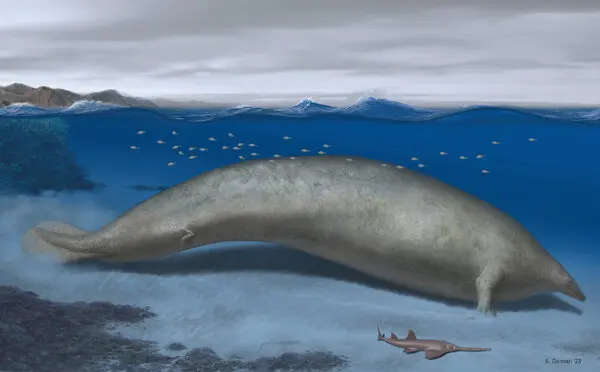

Paleontologists have unearthed a completely new species of prehistoric whale from a 25-million-year-old fossil found on a beach in Australia. This is a very unusual and fascinating find. The fragmentary skull, which features ear bones and teeth, has given us new information about the “feral” and mysterious relatives of today’s gentle giants.
The Zoological Journal of the Linnean Society wrote on the new species, which is officially called Janjucetus dullardi. This strange animal was small enough to fit on a single bed, yet it had sharp teeth and a snout like a shark, making it a dangerous predator.
The Evolution of a Hunter Who Looks Cute
Erich Fitzgerald, a senior curator at the Museums Victoria Research Institute and one of the paper’s authors, said that the species was “deceptively cute.” This ancient predator would have looked very different from any modern creature. Its body was “some weird kind of mash-up between a whale, a seal, and a Pokémon,” and its eyes were the size of tennis balls. Scientists think that the ancient mammalodontid could have been as long as 3 meters (10 feet) and may have even had “tiny little nubbins of legs.”
This is an extremely important find because Janjucetus dullardi is only the fourth species ever found from the mammalodontid group. This group lived during the Oligocene Epoch, which was between 34 and 23 million years ago. These results are important for figuring out how ancient cetaceans changed to live in warmer oceans. This could help us learn more about how marine life today might react to climate change.
Amateur Fossil Hunter’s Life-Long Obsession Pays Off
Amateur fossil hunter Ross Dullard found the uncommon specimen on a stretch of Jan Juc Beach in Victoria state that is known for having a lot of fossils. Dullard, the principal of a school, knew he had found something exceptional when he saw a black item sticking out of a cliff and it knocked out a tooth. This week, his find, which he has been fascinated with for six years, was finally confirmed, and his friends and family gave him high fives. Dullard stated, “It’s literally been the best 24 hours of my life.”
This is only the third mammalodontid recovered in Australia since 2006, hence the find is highly unusual. The fossil record for cetaceans is thin because of millions of years of erosion, scavengers, and ocean currents. Fitzgerald said, “Only the chosen few, the vast minority of all whales that have ever lived and died in the oceans over millions of years, actually get preserved as fossils.”
The confirmation of Janjucetus dullardi offers an enticing insight into a significant epoch of cetacean evolution. The fragmentary skull has already given us clues about how prehistoric whales ate, moved, and acted, but we need more of the skeleton to figure out how their bodies were built.
Janjucetus dullardi, an ancient whale, was found as a fossil in Australia by paleontologists at Museums Victoria. The whale’s evolution and the Oligocene Epoch are also related to this finding.