


With slightly more than 100 days remaining until the 2026 FIFA World Cup begins in the United States, Iran’s participation in the tournament has suddenly been thrown into doubt. The uncertainty follows joint US and Israeli military strikes on Iran and the reported killing of Supreme Leader Ali Khamenei, a development that has left the country’s political future deeply unclear.
Iran had successfully qualified for what would have been their fourth consecutive World Cup appearance. The team was scheduled to play its group-stage matches against New Zealand national football team and Belgium national football team in Los Angeles, before facing Egypt national football team in Seattle.
However, Mehdi Taj, head of the Iranian Football Federation, has reportedly questioned whether participation remains realistic in light of the US military action. The political vacuum following Khamenei’s death has only deepened the uncertainty, raising questions about governance, travel logistics, and the country’s overall readiness to compete on the global stage.
FIFA Monitoring Situation Closely
World football’s governing body, FIFA, says it is closely monitoring developments. According to reports from BBC, FIFA privately expects Iran to take part despite the turmoil.
FIFA Secretary General Mattias Grafström reiterated that the organization’s priority remains delivering a “safe World Cup with everybody participating.” Publicly, FIFA has maintained a stance of neutrality, emphasizing its commitment to inclusivity and security.
If Iran were to withdraw voluntarily or face circumstances preventing participation, potential replacement teams from the Asian Football Confederation could include Iraq national football team or the United Arab Emirates national football team, though no formal contingency plan has been announced.
Meanwhile, Iran’s women’s national team remains in Australia, preparing for the AFC Women’s Asian Cup in Gold Coast. Head coach Marziyeh Jafari has publicly kept the focus on football, steering clear of political commentary despite the escalating crisis back home.
Security and Political Challenges for the United States
The unfolding situation presents significant security and diplomatic challenges for US authorities ahead of the tournament.
President Donald Trump previously signed an executive order restricting entry to nationals from 12 countries, including Iran. While players and coaching staff are exempt from the travel ban, the broader geopolitical tensions are likely to heighten scrutiny around Iran’s matches.
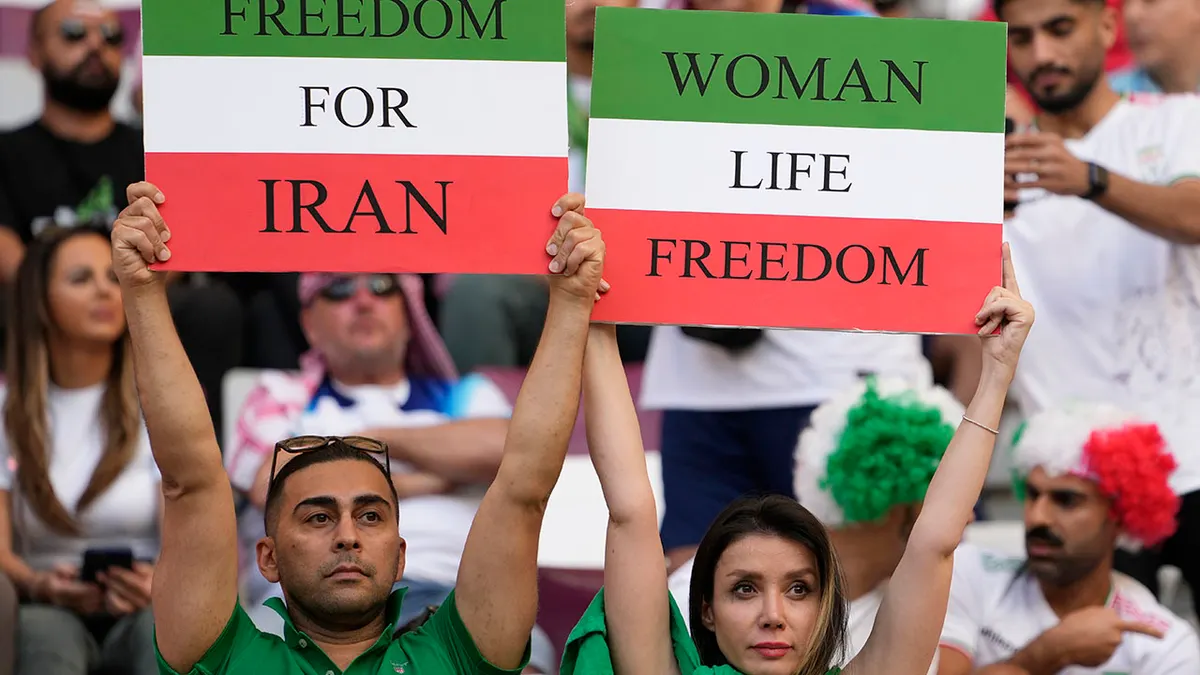
Iran’s group fixtures in Los Angeles — home to one of the largest Iranian diaspora communities in the world — are expected to attract intense security planning. During the 2022 FIFA World Cup in Qatar, Iran’s games were marked by protests and visible divisions among supporters, reflecting tensions between those backing the government in Tehran and those opposing it. Similar confrontations could resurface on American soil this summer.
FIFA, Trump and the “Peace Prize” Debate
The crisis has also reignited debate around FIFA’s leadership and its perceived political positioning.
In December, FIFA awarded President Trump its inaugural “Peace Prize” during the World Cup draw ceremony for 2026, citing his claimed efforts in brokering ceasefires and attempting to resolve international conflicts. Since then, US military actions in Venezuela, Nigeria and Iran have prompted criticism over FIFA’s alignment with political power.
FIFA president Gianni Infantino defended the award last month and appeared at a White House peace board meeting wearing a Trump-branded cap referencing his presidential terms — a gesture that drew mixed reactions globally.
Political responses have spread beyond the United States. An official from the German Football Association raised the possibility of a boycott in protest against US foreign policy decisions.
FIFA insists it has a statutory obligation to remain neutral. The organization faced comparable challenges during the 2018 FIFA World Cup, which went ahead in Russia despite geopolitical tensions. Later, Russia was banned from international competitions in 2022 following its invasion of Ukraine, after several European nations refused to compete against it.
Infantino has since suggested that isolating Russia has not delivered the intended outcomes and has expressed interest in lifting sanctions. Notably, there has been no public indication within FIFA of any appetite to sanction the United States, even amid the current tensions.
A World Cup Shaped by Geopolitics
The 2026 tournament was already expected to carry political symbolism, coinciding with celebrations marking 250 years since the US Declaration of Independence. Now, it risks becoming one of the most politically charged World Cups in modern history.
Whether Iran ultimately competes, withdraws, or is replaced, the situation underscores how deeply intertwined football and geopolitics have become. The coming months will test FIFA’s neutrality, US security preparedness, and the broader principle that global sport can remain insulated from international conflict.
As kickoff approaches, the world waits not just for team selections and tactical previews — but for clarity on whether one of Asia’s top-qualified teams will even take the field.