

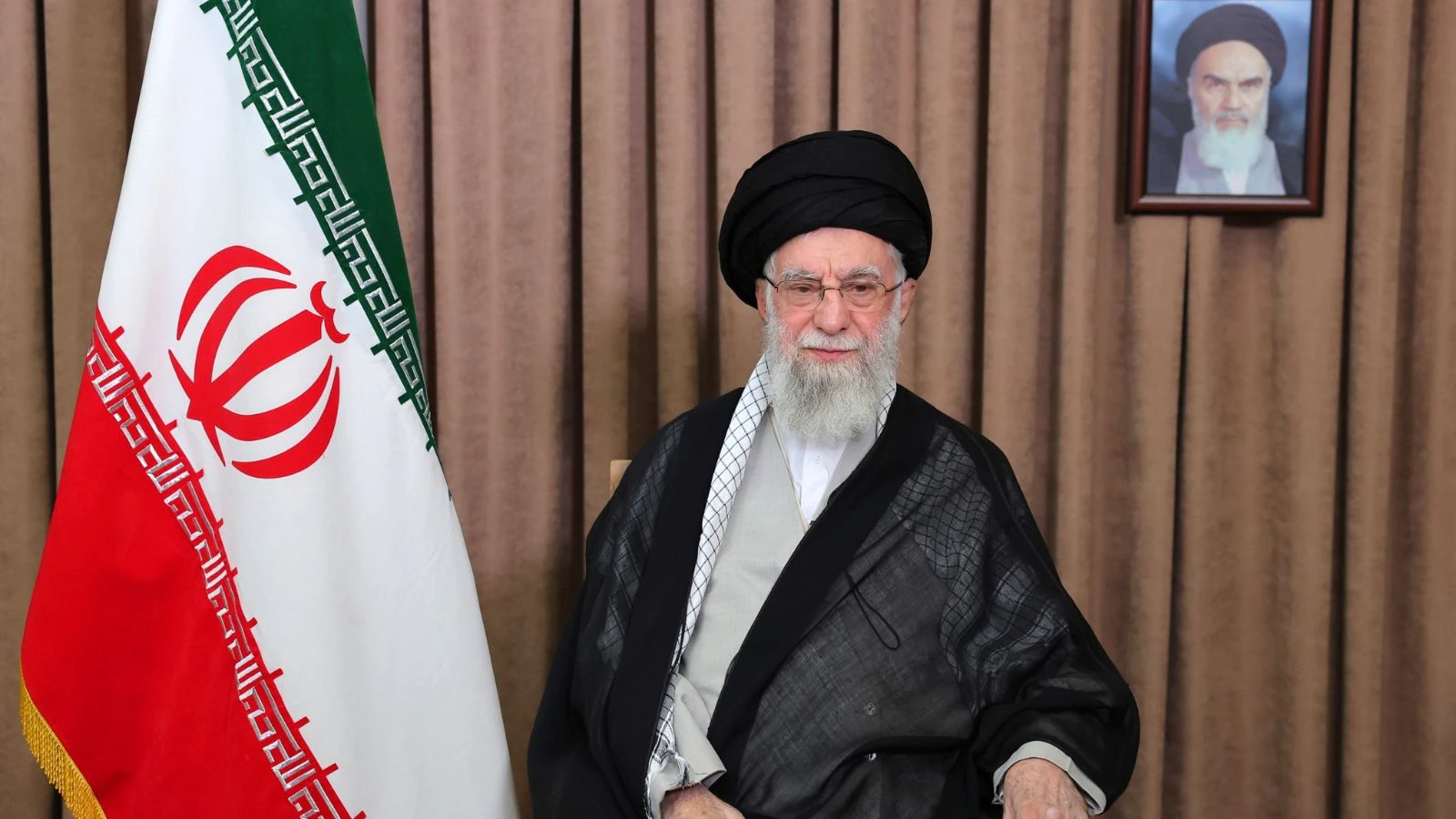

Among the earliest targets of the coordinated US-Israeli strikes on Iran on Saturday was the headquarters compound of Iran’s Supreme Leader, Ali Khamenei, a central figure in the Islamic Republic’s power structure for more than three decades.
Satellite imagery showed significant damage to Khamenei’s compound in Tehran. However, his exact whereabouts remained unclear. A source familiar with the situation said the 86-year-old cleric had been moved in advance to a secure location outside the capital. Independent confirmation of his status was not immediately available.
An Israeli official reportedly indicated that the strikes had aimed to eliminate him — a move that, if successful, would have dealt an unprecedented blow to the Islamic Republic he has led since 1989.
The Gravest Crisis of His Rule
Even before the latest escalation, Khamenei was navigating what many observers describe as the most severe crisis of his 36-year tenure.
He has been attempting to manage fraught negotiations with the United States over Iran’s nuclear programme while facing rising domestic unrest and diminishing regional influence.
Earlier this year, his government ordered one of the deadliest crackdowns since the 1979 Islamic Revolution. Nationwide protests — initially triggered by soaring prices and economic distress — escalated into anti-regime demonstrations. Security forces opened fire on protesters chanting “Death to the dictator!”, following Khamenei’s warning that those protesting should be “put in their place.”
Just last June, Khamenei reportedly went into hiding during 12 days of airstrikes carried out by Israel and later joined by the United States. That offensive killed several of his close associates and senior commanders of the Revolutionary Guards, while also damaging key nuclear and missile infrastructure.
Regional Influence Under Strain
The current confrontation is rooted in the broader regional fallout from the October 7, 2023 attack on Israel by Hamas, an Iranian-backed Palestinian group. The attack triggered the Gaza war and prompted Israel to intensify operations against Iran’s network of regional allies.
Since then, Hezbollah in Lebanon has been significantly weakened, and Syrian President Bashar al-Assad — another key ally — has been toppled. These developments have curtailed Tehran’s influence across the Middle East.
Meanwhile, Washington has pressed Iran to abandon its ballistic missile programme, widely viewed as Tehran’s primary strategic deterrent against Israeli or Western military action.
Khamenei has refused even to discuss relinquishing the missile programme, arguing it is essential for national defence. That refusal may have hardened positions in Washington and Jerusalem, potentially contributing to the latest round of airstrikes.
A Leader Shaped by Revolution and War
Khamenei’s worldview has been shaped by decades of upheaval — from the revolution that toppled the Shah to the brutal 1980–88 Iran-Iraq war, and years of confrontation with the United States.
Though Iran has elected presidents and a parliament, no major policy decision — particularly regarding the United States — proceeds without the Supreme Leader’s explicit approval. Khamenei’s authority rests on a hybrid system combining clerical oversight with limited electoral processes, ensuring ultimate control remains concentrated in his office.
From Unlikely Successor to Supreme Authority
When he succeeded Ruhollah Khomeini in 1989, Khamenei was widely seen as an unlikely choice. He did not initially hold the senior religious rank traditionally associated with the role of Supreme Leader and lacked the charisma of his predecessor.
In his early years, he struggled to assert authority. Over time, however, he consolidated power by building a formidable security network loyal directly to him.
Central to that power structure is the Islamic Revolutionary Guard Corps (IRGC) and the Basij paramilitary force, both of which have repeatedly been deployed to suppress dissent — from the contested 2009 presidential election protests to the 2022 demonstrations following the death in custody of Mahsa Amini, and the latest unrest this year.
“Heroic Flexibility” and Tactical Compromise
Despite his hardline rhetoric and deep distrust of the West — particularly the United States — Khamenei has occasionally shown pragmatism when regime survival appeared at risk.
In 2013, he introduced the concept of “heroic flexibility,” signalling that tactical compromise could be acceptable to preserve strategic objectives. This approach paved the way for Iran’s 2015 nuclear deal with six world powers, which he cautiously endorsed as a means to secure sanctions relief and stabilise the economy.
However, then-US President Donald Trump withdrew from the agreement in 2018, reinstating sweeping sanctions. In response, Tehran gradually breached the deal’s nuclear restrictions, reigniting tensions.
A Power Structure Built on Loyalty
Khamenei’s authority also rests on economic foundations. A vast parastatal conglomerate known as Setad — operating under his direct control — has amassed assets worth tens of billions of dollars. These resources have reportedly strengthened the Revolutionary Guards and entrenched his political leverage.
Observers outside Iran often describe Khamenei as deeply secretive and wary of betrayal — an outlook shaped in part by a 1981 assassination attempt in which a bomb concealed in a tape recorder severely injured him and paralysed his right arm.
Earlier in his life, he endured imprisonment and torture under the Shah’s regime for his revolutionary activities, experiences that further shaped his rigid ideological stance.
An Uncertain Future
Now, with visible damage to his compound and regional tensions at boiling point, Khamenei faces perhaps the most perilous chapter of his leadership.
Karim Sadjadpour of the Carnegie Endowment for International Peace once described Khamenei’s ascent as an “accident of history” that transformed a “weak president into an initially weak supreme leader” and eventually into one of the most powerful Iranians of the past century.
Whether he can weather this latest storm — amid military pressure, internal dissent, and shifting regional dynamics — may determine not only his own fate but the future direction of the Islamic Republic itself.