


New Delhi:
Poor visibility and serious infrastructure gaps at Maharashtra’s Baramati airfield have emerged as key concerns in the preliminary investigation into the fatal Learjet 45XR crash that claimed the life of Maharashtra Deputy Chief Minister Ajit Pawar and four others.
The initial findings released by the Aircraft Accident Investigation Bureau (AAIB) paint a troubling picture of weather conditions, operational decisions, and systemic shortcomings at the uncontrolled airfield where the crash occurred.
Visibility Below Prescribed Limits
According to the AAIB report, visibility at the time of landing was reported as just 3 kilometres — significantly below the 5-kilometre minimum required for operations under Visual Flight Rules (VFR). Baramati airfield operates exclusively under VFR conditions, making the visibility shortfall particularly critical.
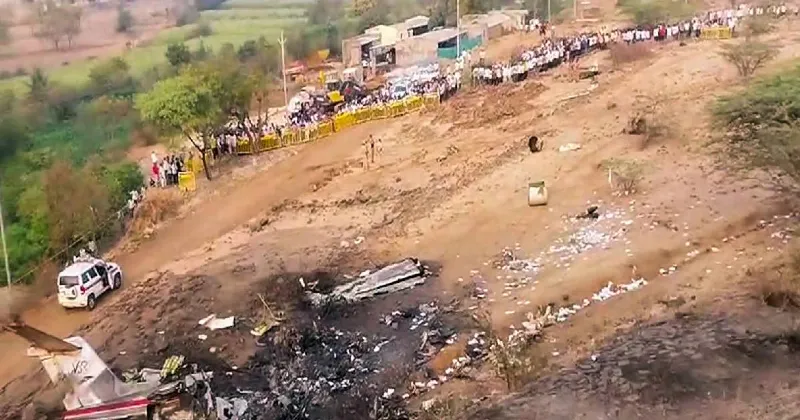
The crash occurred at approximately 8:46 am IST on January 28, when the Learjet 45XR (registration VT-SSK), operated by VSR Ventures Pvt Ltd, was attempting to land on Runway 11. The aircraft had departed from Mumbai on a non-scheduled VIP charter flight.
All five occupants — the Pilot-in-Command, the First Officer, a cabin attendant, and two passengers — died in the crash. The report formally records the “Extent of Injuries: Fatal” for everyone on board.
What Happened During the Landing Attempt
The aircraft first contacted Baramati tower at 8:19:25 am IST. At 8:27:27 am, the crew informed air traffic that they had been released by Pune and were descending from Flight Level 100 to 6,000 feet.
Initially cleared for Runway 11, the crew briefly requested Runway 29 before switching back to Runway 11. Winds were reported calm.
At 8:31:10 am, the crew sought updated visibility data. Three seconds later, the tower responded: “Visibility is 3 km as of now.”
Despite visibility being below the prescribed VFR minimum, the aircraft continued its approach. At 8:34:25 am, the crew reported they were on final approach. Minutes later, at 8:36:36 am, the aircraft announced it was “going around” and would rejoin the left base — abandoning the first landing attempt.
The Final Moments
The second approach began shortly after 8:40 am.
At 8:43:55 am, the crew reported “Field in sight.” Four seconds later, the runway was cleared for landing. However, at 8:44:13 am, cockpit voice recordings captured the words: “Oh St… Oh St…”
The aircraft crash-landed roughly 50 metres to the left of Runway 11, abeam the threshold. CCTV footage from a nearby village showed the jet banking right before impact. According to investigators, the aircraft first struck trees and then hit terrain lower than the runway elevation. It was immediately engulfed in flames, destroying both cockpit and cabin.
Weather and Meteorological Gaps
The report makes a significant observation about weather reporting at Baramati. The airfield does not have a certified meteorological facility. Instead, weather updates are relayed from temporary towers run by flying training organisations. Visibility assessments rely on visual markers and VFR standards.
On the day of the crash, visibility was recorded at 3 km — well below the mandated 5 km minimum for VFR flights.
Satellite imagery suggested shallow fog patches in and around Baramati at the time of the accident. METAR data from nearby Pune airport indicated visibility had dropped to 2,000 metres between 8:10 am and 8:30 am IST.
Infrastructure and Safety Concerns at Baramati
The AAIB report highlights several infrastructure shortcomings at the airfield, which has been managed by Maharashtra Airport Development Company Limited since August 2025.
Key concerns include:
- Uncontrolled airfield status with no navigational aids beyond windsocks.
- Only one runway (11/29 orientation).
- Both windsocks positioned toward the Runway 29 side — none on the Runway 11 side.
- Faded runway markings and loose gravel on the runway surface. The last re-carpeting was carried out in March 2016.
- No in-house Aircraft Rescue & Fire Fighting (ARFF) unit.
- Inadequate perimeter fencing and absence of a boundary wall.
- A “tabletop” feature at the beginning of Runway 11, indicating terrain drop-offs at one end.
These findings raise broader concerns about operational readiness and regulatory oversight at smaller, uncontrolled airfields handling VIP and charter operations.
The Crew and Aircraft Details
The 61-year-old Pilot-in-Command held an Airline Transport Pilot Licence and had logged 18,855 total flying hours, including more than 2,800 hours on the Learjet 45XR. The 25-year-old First Officer possessed a Commercial Pilot Licence with over 2,400 flying hours. Both had prior experience operating into Baramati and other uncontrolled airfields.
Pre-flight breath analyser tests conducted that morning were negative. Post-mortem reports concluded the cause of death was “multiple injuries associated with burn injuries (Unnatural).”
The aircraft had a valid Certificate of Airworthiness and Airworthiness Review Certificate. It was not operating under any Minimum Equipment List restrictions at the time of the flight.
Flight Recorders and Ongoing Investigation
Both the Solid-State Flight Data Recorder (FDR) and Cockpit Voice Recorder (CVR) were recovered from the wreckage’s tail section. The FDR data has been successfully downloaded and is currently under analysis.
The CVR suffered thermal damage. Assistance has been sought from the United States under ICAO Annex 13 provisions to retrieve the data.
The AAIB emphasised that the report is preliminary and subject to change. It reiterated that the purpose of the investigation is accident prevention, not assigning blame.
Interim Safety Recommendations
The AAIB has issued interim recommendations to the Directorate General of Civil Aviation (DGCA), including:
- Strict enforcement of Standard Operating Procedures for VFR operations at uncontrolled airfields.
- Ensuring flights operate only when meteorological conditions meet prescribed minima.
- Improving landing aids and establishing basic certified meteorological facilities.
- Reviewing the feasibility of formally licensing such aerodromes for regulated and safe operations.
Current Status of the Probe
The Flight Data Recorder is still being analysed. Retrieval of the Cockpit Voice Recorder data awaits international technical assistance. Investigators have recorded statements from the operator and air traffic controller, secured the wreckage for detailed examination, and seized relevant airworthiness and operational documents.
The investigation remains ongoing, with authorities working to determine the root cause and any contributing factors behind one of Maharashtra’s most devastating aviation tragedies.