

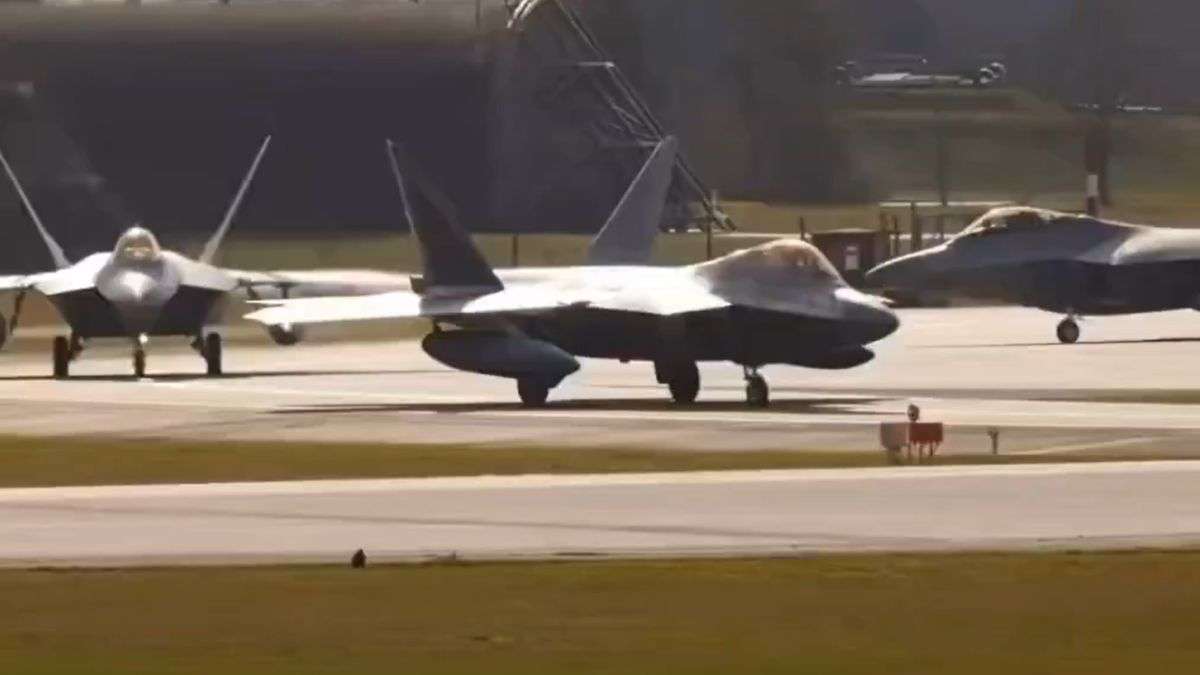

The United States has, for the first time, deployed frontline combat aircraft directly to Israel as tensions with Iran escalate and the possibility of open conflict looms. According to a report by The Wall Street Journal, advanced F-22 Raptor jets have been stationed at Israeli air bases, marking an unprecedented operational step in US-Israeli military cooperation.
The stealth fighters are expected to play a critical role in defending Israeli territory and protecting American troops in the region in the event of Iranian retaliation. “Operating aircraft from Israeli bases is a first,” Dennis Ross, a former senior US official, told the publication, underscoring the significance of the move.
Why Has the US Deployed the Jets to Israel?
The deployment comes amid growing logistical constraints for Washington in the Middle East. Both Saudi Arabia and the United Arab Emirates have reportedly refused to allow US forces to use their airspace for potential operations related to Iran. This has limited American basing options in the Gulf, traditionally a launchpad for regional missions.
Elliott Abrams, who served as a special envoy for Iran during the first Trump administration, told The Wall Street Journal that the decision reflects two key developments: “the growing cooperation between the United States and Israel, and the refusal of so many countries to allow the US to use their bases.”
Abrams added pointedly, “I have to wonder if, over time, Americans will wonder why we have bases in countries that don’t cooperate when we ask.”
Stealth Fighters Spotted En Route to Israel
According to open-source flight tracking data and aircraft spotters cited by Israeli media, the F-22 jets were seen taking off from the RAF Lakenheath in the United Kingdom on the morning of February 24 before flying onward to Israel.
The F-22 Raptor is among the US Air Force’s most advanced stealth platforms, capable of air superiority missions, deep strike operations, and defensive counter-air roles. Its deployment to Israel signals that Washington is preparing for a broad spectrum of contingencies.
Israeli Officials See Strike as Increasingly Likely
Israeli officials reportedly believe that a US strike on Iran is becoming increasingly inevitable. Senior military officials from both countries are said to have been in close contact as the crisis deepens.
One Israeli official quoted by Channel 12 news suggested that a diplomatic breakthrough would be the “surprise of the year,” according to The Times of Israel.
From Caution to Closer Integration: A Strategic Shift
For decades, Washington deliberately kept its permanent military footprint in Israel limited. US policymakers feared that stationing offensive aircraft there could inflame tensions across the Arab world.
To manage these sensitivities, Israel was historically placed under the United States European Command (EUCOM). However, that arrangement changed following the Abraham Accords, which reshaped regional alliances.
In 2021, Israel was reassigned to the United States Central Command (CENTCOM), a move that removed longstanding operational barriers and significantly deepened US-Israeli military integration. The current deployment of F-22s is widely seen as a direct outcome of that strategic realignment.
US-Iran Nuclear Talks Continue Amid Military Buildup
The military escalation comes even as diplomatic talks between Washington and Tehran over Iran’s nuclear programme continue in Geneva.
During his address to a joint session of the US Congress, US President Donald Trump warned that Iran is developing long-range missile capabilities that could eventually reach American territory.
“They’ve already developed missiles that can threaten Europe and our bases overseas, and they’re working to build missiles that will soon reach the United States of America,” Trump said in his first State of the Union address of his second term.
“My preference is to solve this problem through diplomacy—but one thing is certain: I will never allow the world’s number one sponsor of terror to have a nuclear weapon,” he added.
Meanwhile, Iran’s foreign ministry stated that delegations from both countries have exchanged “very constructive” proposals during the third round of talks in Geneva, raising cautious optimism about a potential diplomatic path forward.
A Delicate Balance Between Deterrence and Diplomacy
The deployment of F-22 Raptors to Israeli soil represents a major symbolic and operational shift in US strategy. It reflects both a hardening military posture toward Iran and a deepening alliance with Israel at a time when regional partners appear increasingly reluctant to be drawn into direct confrontation.
As negotiations over Iran’s nuclear programme continue, Washington’s military buildup sends a dual message: diplomacy remains the preferred route, but preparations for conflict are well underway.