

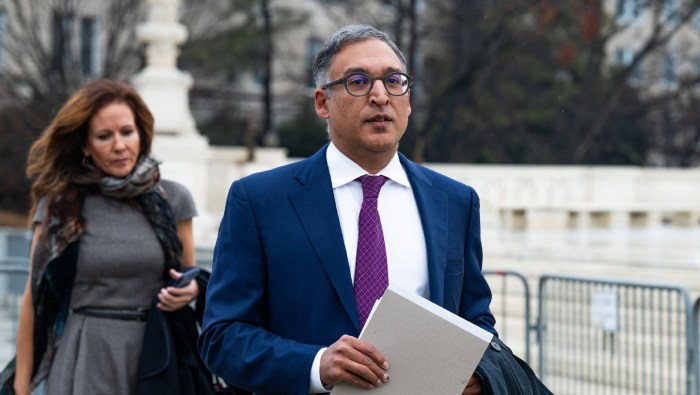

WASHINGTON, D.C. — Neal Katyal, the former Acting Solicitor General and son of Punjabi immigrants, has once again reshaped the American legal landscape. Speaking to HT hours after the verdict, Katyal emphasized that the Supreme Court’s decision reinforces a fundamental principle: the power to tax and levy tariffs belongs to Congress, not the White House.
Key Highlights from the media interview
- A Constitutional Victory: Katyal noted that the President cannot “disregard the Constitution” in the name of national security or the economy. “Presidents are powerful, but our Constitution is more powerful still,” he remarked.
- Overcoming Deference: Historically, the Court has rarely struck down a President’s “signature initiative.” Katyal acknowledged the risk, citing his 2017 loss in the “Muslim Ban” case, but noted that the 6-3 majority (including Justices Roberts, Gorsuch, and Barrett) found the legal case against these tariffs undeniable.
- The “Section 122” Fallback: Within hours of the ruling, President Trump invoked Section 122 of the Trade Act of 1974 to impose a new 15% global tariff. Katyal called this legal ground “shaky,” pointing out that the DOJ previously argued in court that Section 122 did not apply to trade deficits.
- The Personal Toll: Katyal shared that he was thinking of his father, who immigrated from India for the promise of a fair legal system. “To be part of that and to remind the court… of our deepest principles—I don’t have words to describe what that feels like.”
What Happens Now?
The ruling has significant immediate consequences for the global economy and U.S. importers:
- Refund Task Force: Katyal has already launched a legal task force to help businesses reclaim an estimated $133 billion to $142 billion in tariffs collected over the past year.
- India-US Trade: While the IEEPA tariffs are gone, India now faces the new 15% surcharge. However, Katyal predicts this new levy will be struck down in court within months.
- The 150-Day Clock: Tariffs under Section 122 are legally limited to 150 days (expiring July 24, 2026) unless specifically authorized by a vote in Congress—a move Trump has historically avoided.
Comparison: IEEPA vs. Section 122
| Feature | IEEPA (Struck Down) | Section 122 (Current Fallback) |
| Authority | National Emergency (Executive) | Balance of Payments (Executive) |
| Duration | Indefinite | Max 150 Days (without Congress) |
| Max Rate | Unlimited | Cap of 15% |
| Legal Status | Unconstitutional (SCOTUS 6-3) | Shaky; Facing new challenges |