

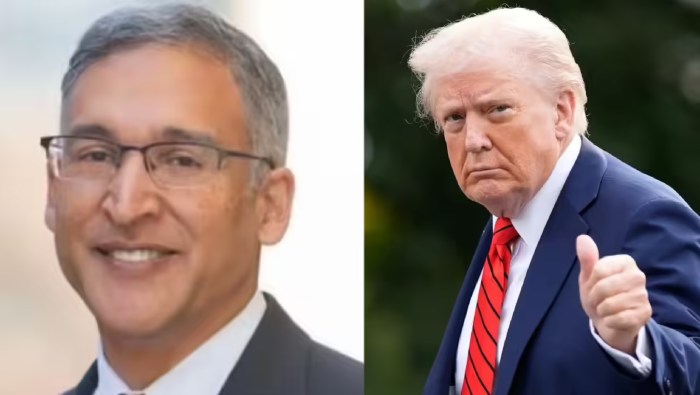

WASHINGTON, D.C. — In a ruling that authored a new chapter in American constitutional law, the Supreme Court ruled on Friday, February 20, 2026, that the President overstepped his authority by using the International Emergency Economic Powers Act (IEEPA) to unilaterally impose global tariffs.
While President Trump reacted with fury—calling the majority “fools” and stating he was “absolutely ashamed” of the justices—Neal Katyal, representing a coalition of small businesses, celebrated a “complete and total victory” for the rule of law.
The Architect of the Challenge: Who is Neal Katyal?
Born in Chicago to Indian immigrant parents—a doctor and an engineer—Neal Katyal has become one of the most significant legal minds in modern US history.
- Record Breaker: By age 53, Katyal had argued more Supreme Court cases than any other minority attorney in US history. This latest win marks his 50th argument before the high court.
- Veteran Litigator: A former Acting Solicitor General and National Security Adviser, Katyal is currently the Paul Saunders Professor at Georgetown University.
- The Winning Argument: Katyal, alongside Sara Albrecht of the Liberty Justice Center and his team at Milbank, argued that the IEEPA was never intended to give a president a “blank check” to tax imports.
“Presidents are powerful, but our Constitution is more powerful still,” Katyal posted on X. “In America, only Congress can impose taxes on the American people.”
A Fragmented Bench: The 6-3 Split
The ruling was authored by Chief Justice John Roberts, who was joined by a surprising coalition that included two Trump appointees from his first term.
The Majority (Struck Down Tariffs):
- Chief Justice John Roberts
- Justice Neil Gorsuch (Trump appointee)
- Justice Amy Coney Barrett (Trump appointee)
- Justice Sonia Sotomayor
- Justice Elena Kagan
- Justice Ketanji Brown Jackson
The Dissent (Supported Trump):
- Justice Clarence Thomas
- Justice Samuel Alito
- Justice Brett Kavanaugh (Trump appointee)
The dissenters argued that the broad language of the law should have permitted the President’s actions, but the majority held firm that tariff-setting powers are reserved strictly for Congress unless explicitly delegated.
The Immediate Retaliation: Trump’s “Section 122” Pivot
The victory for Katyal’s clients may be legally historic, but it didn’t stop the trade war. Within hours of the ruling, President Trump signed a new executive order from the Oval Office.
- The New Order: A 10% global tariff on all countries, effective “almost immediately.”
- The Legal Shift: Trump is now invoking Section 122 of the Trade Act of 1974, which allows for a 150-day import surcharge to address balance-of-payments problems.
- The Refund Battle: While the new tariffs take effect, US businesses have already begun filing for refunds for the estimated $175 billion paid under the now-illegal IEEPA regime.
What it Means for Global Partners
White House officials indicated that trade deals already in motion—such as the recent framework with India—will largely remain intact, though baseline rates will shift to the new 10% level until fresh Section 301 investigations are concluded.
For Neal Katyal and the American legal community, however, the day wasn’t about the specific dollar amount of the tax, but about the principle of the presidency. “This case has always been about the presidency, not any one president,” Katyal noted. “It’s about the separation of powers.”