

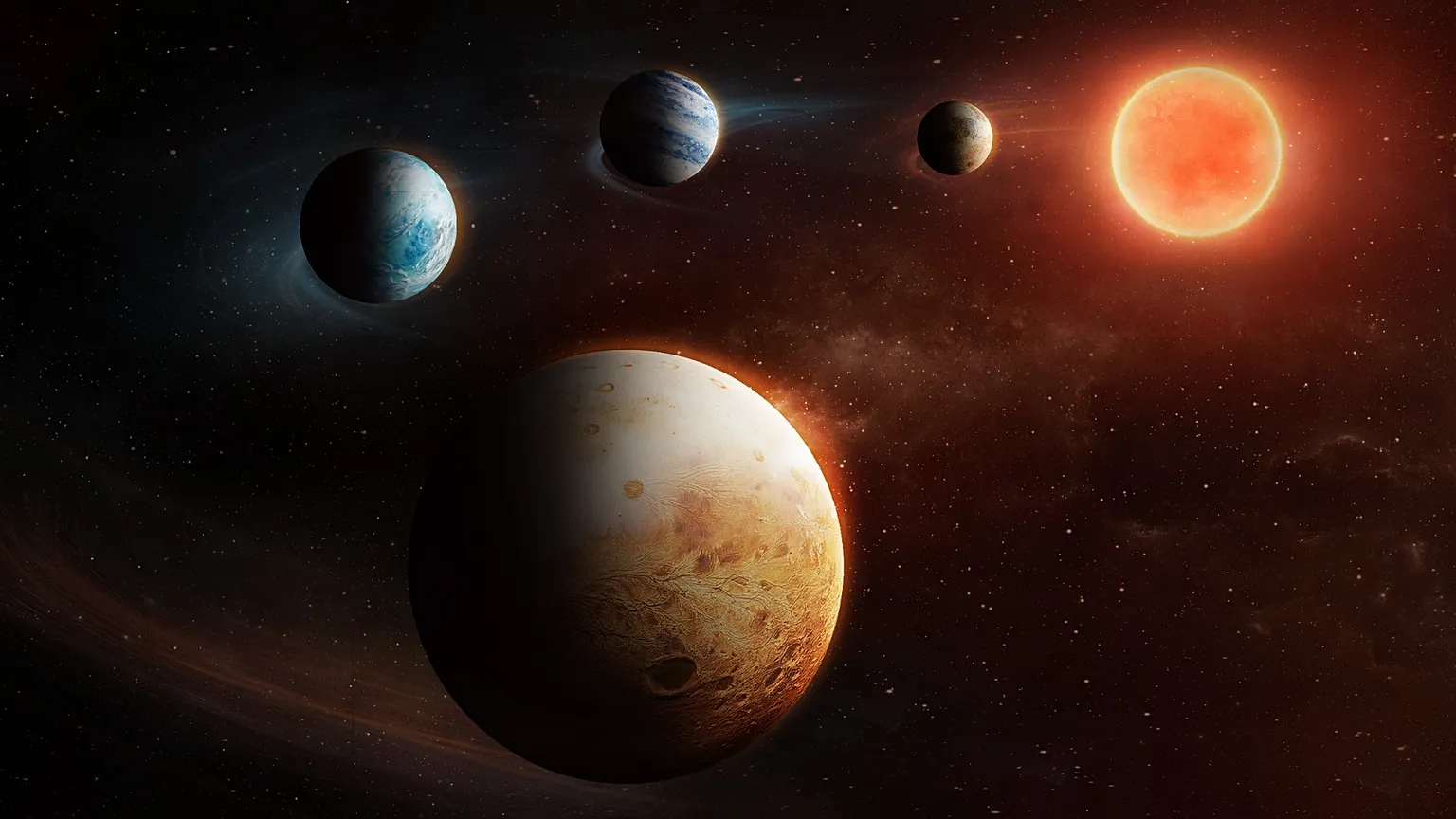

Astronomers have discovered a rare and unusual “inside-out” planetary system around a faint red dwarf star, LHS 1903, featuring a rocky planet located on the outer edge of the system rather than close to the star. This surprising configuration challenges long-standing theories about how planets form and evolve.
In most known planetary systems, including our solar system, rocky planets typically form close to their host stars, while gas giants develop farther away where colder conditions allow gas to accumulate. However, this newly identified system flips that pattern, with a rocky world found beyond gas planets—a configuration rarely observed.
Discovery Led by University of Warwick Using ESA’s CHEOPS Mission
The discovery was led by researchers at the University of Warwick using data from the European Space Agency’s CHEOPS (Characterising Exoplanet Satellite) mission. According to a Science report, the system contains four known planets: a rocky inner planet, two gas planets in the middle, and an unexpected rocky planet in the outer region.
This arrangement contradicts traditional planetary formation models, which suggest that inner planets lose their gas envelopes to become rocky, while outer planets retain gas and grow into giants. The presence of a distant rocky planet suggests it may have formed without accumulating significant gas in the first place.
“Inside-Out” Formation Model Gains Support
Scientists ruled out scenarios such as planets swapping orbits or being displaced by violent collisions. Instead, the evidence points to an “inside-out” planet formation process. In this model, planets form sequentially from the inside outward, as the disc of gas and dust evolves and gradually loses gas over time.
This means the outer planet could have formed later, when less gas was available, resulting in a rocky composition instead of a gaseous one.
Implications for Planetary Science
If confirmed in other planetary systems, this discovery could significantly reshape scientists’ understanding of planetary formation and evolution. It suggests that planets can form under a wider range of conditions than previously thought and that planetary systems may be more diverse and complex than existing models predict.