

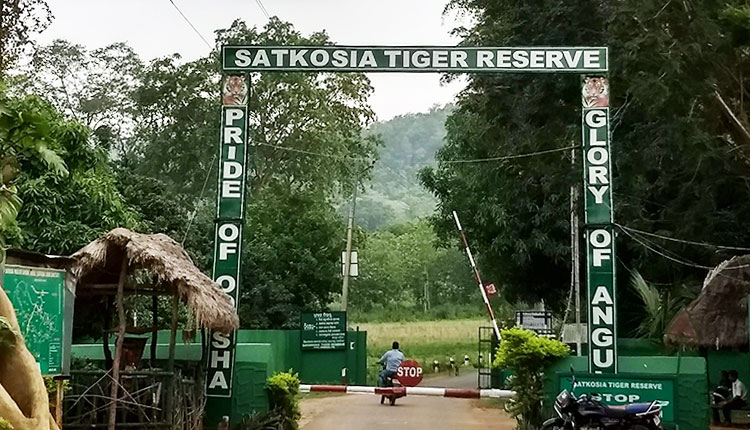

BHUBANESWAR — In a major intervention for forest dwellers’ rights, the Odisha Human Rights Commission (OHRC) has ordered a high-level probe into the “flawed” relocation of residents from villages surrounding the Satkosia Tiger Reserve. The order, passed on February 9, 2026, explicitly prohibits the state government from undertaking any further relocations from buffer or fringe villages until all forest rights are legally recognized and valid Gram Sabha resolutions are secured.
The ruling follows a series of petitions from residents of villages including Bhurukundi, Asanbahal, Kataranga, Tuluka, Tikarapada, and Gopalpur, who alleged that the administration bypassed mandatory legal protocols to clear forest land.
1. Key Violations Flagged by the Commission
The OHRC’s investigation revealed that the relocation process, which began in 2017, suffered from “serious procedural infirmities” that undermined the constitutional rights of the affected families:
- Bypassing the Forest Rights Act (FRA): Relocations were initiated without the prior recognition and settlement of individual and community forest rights. The commission noted that without this settlement, any “consent” obtained from villagers is legally infirm.
- Gram Sabha Irregularities: Meetings were often conducted without proper notice, lacked a required quorum, or were held in a hurried manner that prevented informed participation.
- Non-Transparent Enumeration: Lists of beneficiaries were altered arbitrarily, leading to the exclusion of eligible persons—such as married daughters, persons with disabilities, and long-term residents—while ineligible individuals were reportedly added.
- Unscientific Compensation: Compensation was disbursed without a fair valuation of houses, land, trees, livestock, and other livelihood assets, causing “grave hardship.”
2. The High-Level Inquiry Committee
The OHRC has directed the Chief Secretary to form a multi-departmental committee within four weeks. The probe must be completed within six months.
| Committee Composition | Key Mandates |
| Chair: To be decided by the Chief Secretary | Conduct a village-wise audit of the relocation process. |
| Forest & Environment Secretary | Verify the accuracy of beneficiary lists and identify wrongful exclusions. |
| Revenue & ST/SC Development Secretaries | Assess the adequacy of compensation and recommend corrective payments. |
| Law Secretary | Identify officers responsible for violations and recommend departmental/criminal action. |
| Independent Expert | Ensure compliance with the Forest Rights Act and NTCA guidelines. |
3. Context: Conservation vs. Human Dignity
While acknowledging the ecological importance of creating “inviolate spaces” for tiger conservation, the OHRC observed that such goals “cannot be pursued by disregarding statutory safeguards and human dignity.” Notably, the commission pointed out that many of the affected habitations are “ringed-out” areas or revenue villages where NTCA guidelines do not strictly mandate relocation. Since the state chose to relocate these communities, it was bound by the Right to Fair Compensation (LARR) Act, 2013 and constitutional safeguards.
4. Satkosia Tiger Reserve: Fast Facts
- Location: Spans Angul, Cuttack, Nayagarh, and Boudh districts.
- Status: Declared a Tiger Reserve in 2007; currently part of the Mahanadi Elephant Reserve.
- History: Site of India’s first (and failed) inter-state tiger translocation project in 2018 involving tigers Mahavir and Sundari.