

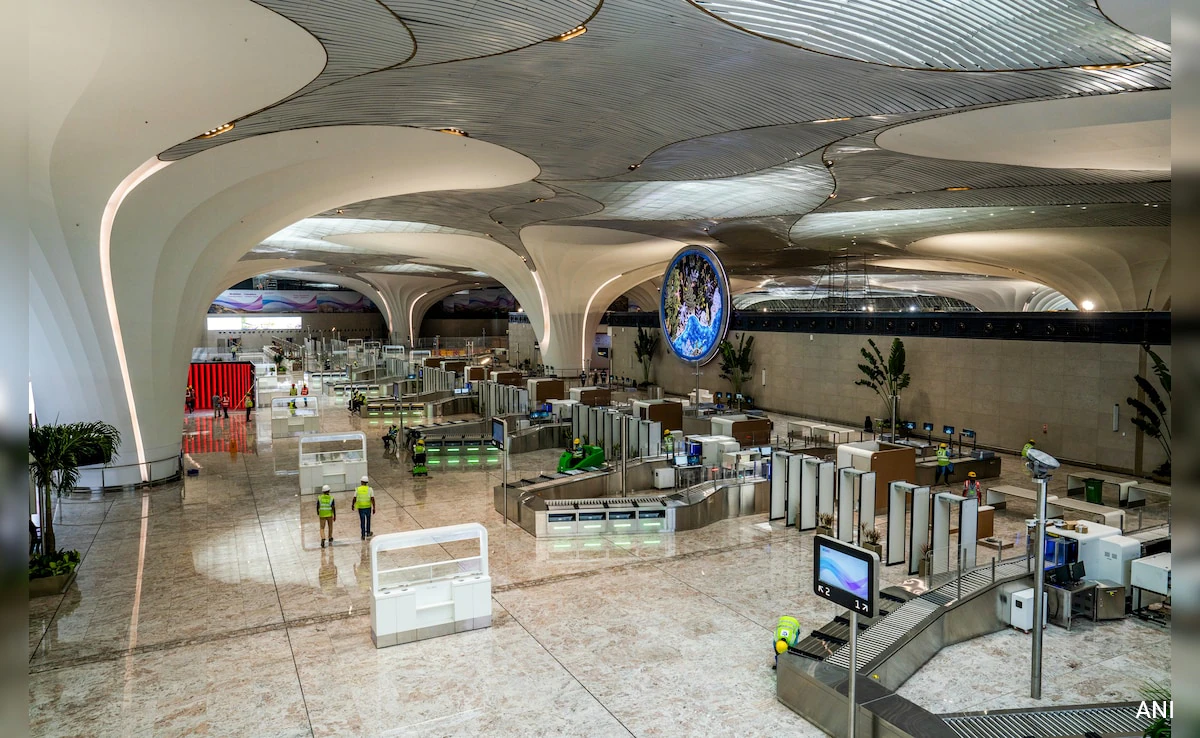

A historic chapter in Indian aviation opened today, Thursday, December 25, 2025, as the Navi Mumbai International Airport (NMIA)—the second gateway for the Mumbai Metropolitan Region—launched its first commercial flights. The launch makes Mumbai the first city in India to operate a dual-airport system.
The “Christmas Gift”: Day One Operations
The Adani Group-promoted airport began its journey with a busy schedule of domestic services.
| Detail | Information |
| First Arrival | IndiGo 6E 460 from Bengaluru at 8:00 AM |
| First Departure | IndiGo 6E 882 to Hyderabad at 8:40 AM |
| Airlines Operating | IndiGo, Akasa Air, Air India Express, and Star Air |
| Destinations | 9 Cities (Delhi, Bengaluru, Hyderabad, Ahmedabad, Kochi, Goa, etc.) |
| Total Movements | 30 Air Traffic Movements (Arrivals/Departures) on Day 1 |
Note: For the first two months, NMIA will operate on a 12-hour cycle (8 AM to 8 PM). Round-the-clock (24/7) operations and international flights are scheduled to begin in February and March 2026, respectively.
The Grand Eve: 1,515 Drones Light Up the Sky
On the eve of the launch (Wednesday, Dec 24), a spectacular drone show transformed the Navi Mumbai skyline into a high-tech canvas.
- The Scale: 1,515 drones moved in perfect synchronization, setting a new benchmark for aerial displays in India.
- The Formations: The show featured 3D lotus blooms (reflecting the terminal’s architecture), the NMIA logo, a plane soaring over Mumbai, and the theme “Rise of India.”
- Sustainability: The “green” drone show was chosen as a smoke-free, eco-friendly alternative to traditional fireworks, aligning with NMIA’s goal to be a sustainable airport.
NMIA: A Future Aviation Giant
Spanning 1,160 hectares, the airport is designed for massive growth over five phases.
- Current Capacity (Phase 1): 20 million passengers per annum (MPPA) and 0.5 million tonnes of cargo.
- Final Capacity (2030s): 90 million passengers per annum and two parallel runways.
- Design Inspiration: The terminal’s architecture is inspired by the lotus, India’s national flower, blending cultural identity with contemporary aesthetics.