

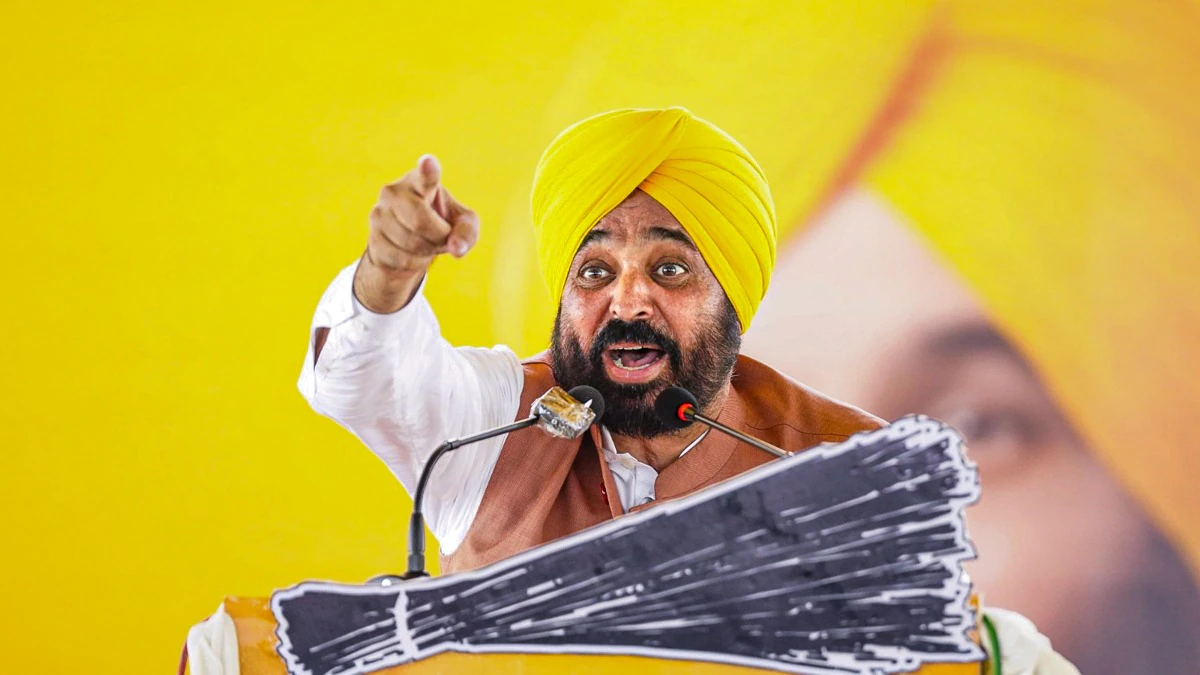

Bhagwant Mann fiercely defended his state and its farmers on Wednesday, categorically refuting the long-standing accusation that stubble burning in Punjab is the single biggest contributor to the toxic haze enveloping the National Capital Region (NCR).
Speaking to the media in New Delhi, Mann described the persistent blame as an “unfair attempt” to malign Punjab’s image, countering the environmental narrative with pointed criticisms based on meteorological facts and regional data.
The Meteorological Argument
Mann dismissed the idea that smoke selectively travels from Punjab to Delhi and then settles over specific areas like Connaught Place, labelling the entire narrative a “joke.” He argued that for smoke to cover the required distance and volume, “air blowing from north to south at 30 kmph for 10 days straight” would be required—a scenario he deemed “unrealistic and scientifically unsound.”
“The smoke from Punjab doesn’t even reach Delhi,” Mann asserted.
AQI Soared Before Fires Began
The Chief Minister shifted the focus to local and regional sources, pointing out that Delhi’s Air Quality Index (AQI) had already breached the 400 mark (categorized as ‘Severe’) even before paddy harvesting and the subsequent stubble burning season had fully commenced in Punjab.
- Current Reality: Delhi’s air quality continues to hover in the ‘Very Poor’ to ‘Severe’ categories, with the overall AQI reported at 391 on Wednesday.
- Scientific Contribution: While the contribution of farm fires in neighboring states to Delhi’s PM2.5 levels has fluctuated, recent data from the Central government’s Decision Support System (DSS) shows the contribution peaking at around 22.47% earlier in the month, though local sources like transport emissions are often the highest single contributor.
Mann asserted that this factual timeline confirms the major contribution of local factors—including vehicular emissions, industrial pollution, and contributions from neighboring states like Haryana, Rajasthan, and Uttar Pradesh—to the capital’s toxic haze.
Decoupling Farmers from the Crisis
Furthermore, Mann sought to decouple the farmers from the pollution crisis by explaining their role in the national food security apparatus.
He explained that “99 per cent of the paddy harvested in Punjab is sent across the country” to meet national food pool requirements, and rice is not even the staple food of the local Punjabi population. He urged that farmers should not be unfairly vilified when the state has not received adequate central financial support or viable alternative machinery and solutions for crop residue management.
The Supreme Court and the Commission for Air Quality Management (CAQM) continue to monitor the situation, repeatedly directing all stakeholders to find comprehensive, long-term regional solutions beyond seasonal restrictions.