

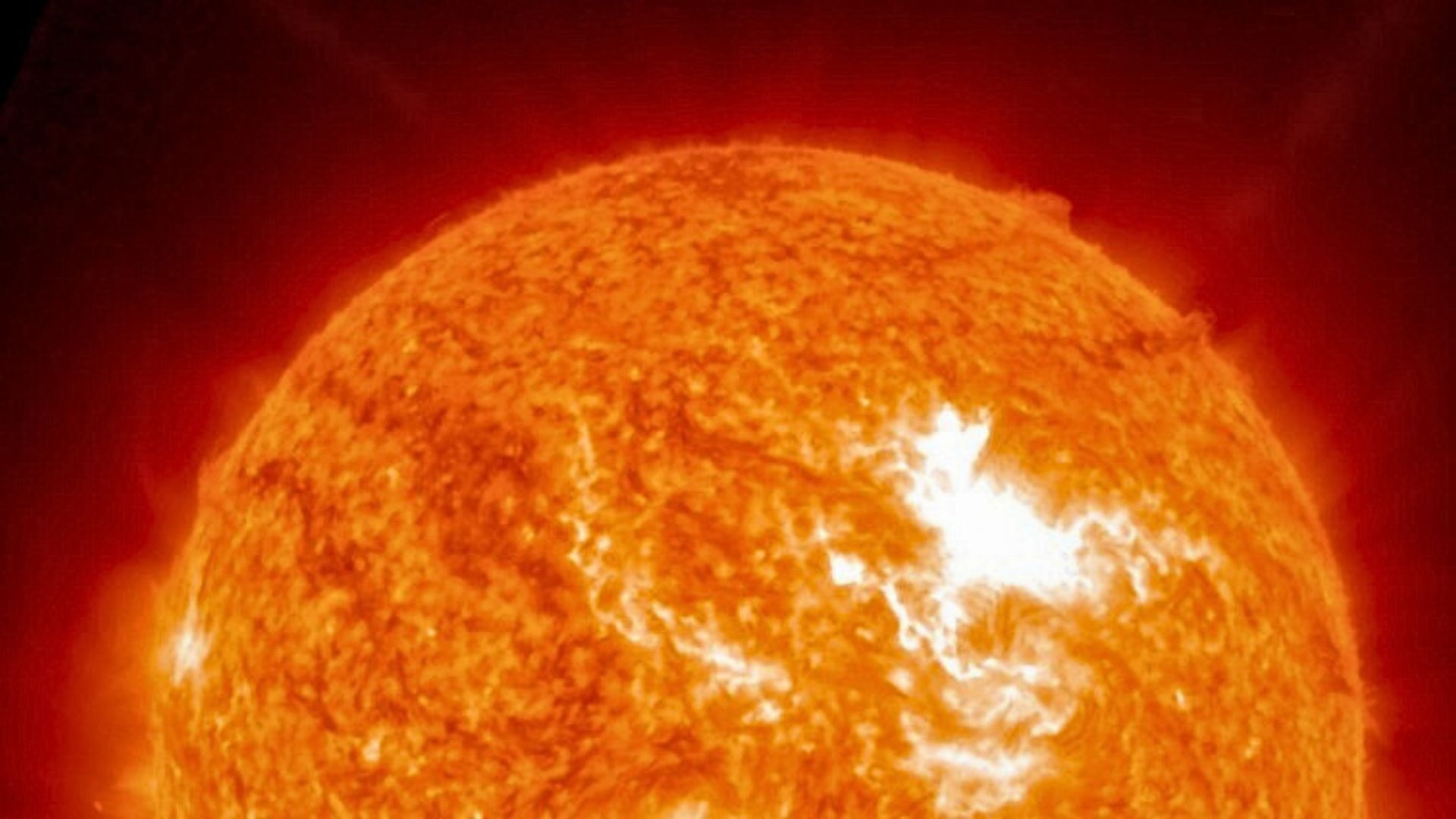

November 11, 2025: The Sun unleashed its most powerful eruption of the year — an X5.1-class solar flare — from active region AR4274, a highly volatile sunspot cluster that has already produced multiple major flares in recent days.
The intense X-class flare, the highest category on the solar scale, struck the daytime side of Earth almost instantly, bombarding the upper atmosphere with ionising X-rays and ultraviolet radiation. The result was widespread shortwave (HF) radio blackouts across Africa and Europe, briefly disrupting aviation, maritime, and emergency communication systems.
Eruption Details
According to a report from SpaceX.com, the flare peaked at 5 a.m. EST (10 a.m. UTC) on November 11 from sunspot AR4274. The same region had already released X1.7 and X1.2-class flares on November 9 and 10, signaling heightened solar activity ahead of the latest explosion.
The event was accompanied by a coronal mass ejection (CME) — a massive cloud of charged solar plasma — launched directly toward Earth. Forecast models from the U.S. National Oceanic and Atmospheric Administration (NOAA) suggest the CME could impact Earth’s magnetic field on November 12, potentially triggering a severe geomagnetic storm.
Impact on Earth: Radio Blackouts and Auroras
The flare’s intense UV and X-ray radiation rapidly ionised Earth’s upper atmosphere, leading to the absorption of high-frequency (HF) radio signals.
The NOAA Space Weather Prediction Center (SWPC) classified the event as a Strong (R3-level) Radio Blackout, indicating wide-area communication disruptions lasting up to an hour. Such events typically affect aircraft communications, maritime operators, and ham radio networks on the sunlit side of the planet.
NOAA also warned that the incoming CME could spark geomagnetic storms on November 12, with potential auroras visible at unusually low latitudes, possibly reaching northern India, southern Europe, and parts of the United States if the storm intensifies to a G4 level or higher.
Solar Cycle 25 Heating Up
Solar physicists note that the Sun is currently near the peak of Solar Cycle 25, marked by heightened magnetic activity and frequent solar eruptions. The X5.1 flare joins a growing list of extreme space weather events this year, underscoring the need for satellite operators, power grid managers, and communication networks to stay alert.
What Happens Next
NOAA’s space weather team will continue to track the CME’s trajectory and update geomagnetic storm forecasts in real-time. If the CME’s magnetic field aligns southward upon arrival, Earth could experience intense geomagnetic activity, leading to vivid auroras and possible satellite drag or power grid fluctuations.