

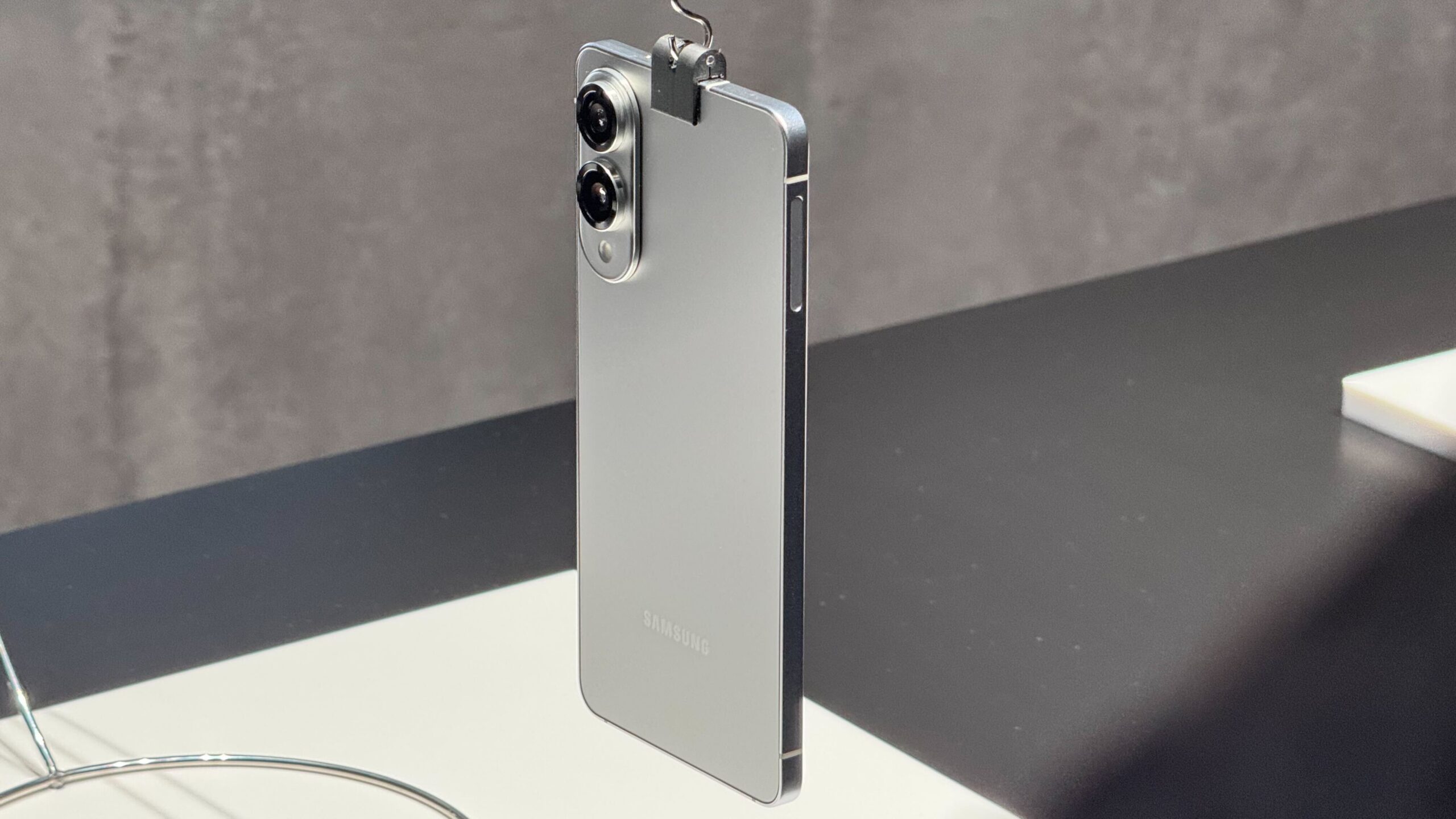

For once, I’m genuinely surprised. Word on the street is that Apple is scaling back production of the iPhone Air barely weeks into its launch, and Samsung is believed to have scrapped plans for a Galaxy S26 Edge after the Galaxy S25 Edge failed to meet sales expectations.2 When industry heavyweights like Ming-Chi Kuo (for Apple) and Sana Securities (for Samsung) signal such shifts, it’s hard to ignore the smoke. But the question remains: why have these ultra-slim devices, which were meant to define 2025’s flagships, fallen short?
The Ultra-Slim Trade-Off: Where Physics Met Wallet Math
The iPhone Air (measuring 3$5.6 \text{mm}$) and the Samsung Galaxy S25 Edge (a slightly thicker 4$5.8 \text{mm}$) were set to show us the future of premium smartphones.5 Yet, their stumble is significant. The responsibility for this setback lies both with the phone makers for their necessary compromises and with potential customers who were swayed by a mix of half-baked social media noise, ingrained habits, and an aversion to the unknown.
While no smartphone is perfect, these ultra-slim devices faced inherent limitations dictated by physics.
The Anxiety and the Nuance: Misinformation vs. Reality
A major stumbling block has been battery anxiety. Consumers basing their purchase decisions purely on screenshots of “screen active” time or raw milliamp-hour (mAh) numbers shared by content creators are missing the bigger picture: nuance.
How many typical users of the iPhone Air or Galaxy S25 Ultra consistently shoot $4\text{K}$ HDR videos or game heavily for an hour daily? Phone makers have deployed chips in these thin form factors that significantly push the performance-per-watt statistic. Consumers who based their decisions on an exaggerated use case or someone else’s assumptions suffered a loss.
The Subjective Truth: Cameras and Cost
Consumers are right to prioritize subjective aspects like durability, cameras, and, critically, price.
This brings us back to the compromises the manufacturers made:
- Camera Compromise: The iPhone Air’s single camera is a sticking point for buyers. Despite the lauded Fusion Camera system, paying $₹1,19,900$ onwards for a flagship with a single rear sensor is seen as a major trade-off.
- Battery Reality: In my experience, the $₹1,09,999$ Galaxy S25 Edge, when fully charged in the morning, would often dip to an uncomfortable $20\%$ to $30\%$ charge remaining by $3 \text{p.m.}$, a noticeable dip when compared to a Galaxy S25 Ultra.
The Road Ahead: Beating Physics and Fixing Pricing
The ultra-slim concept is valuable and shouldn’t be scrapped. The solution lies in addressing these key shortcomings, and beating physics is a challenge tech companies are equipped to handle.
1. Solving Battery Technology
The most obvious fix is advanced battery technology. Silicon-carbon batteries, already appearing in some Chinese flagship phones, offer significantly higher energy density than standard lithium-ion cells. If Apple and Samsung can integrate these, a $5.5\text{mm}$ phone with a $5,000 \text{mAh}$ battery could become feasible. Apple’s attempt with the magnetic iPhone Air MagSafe Battery was a modular (and costly) step; perhaps a more affordable accessory could be the solution.
2. Strategic Pricing and Positioning
The failures of the Galaxy S25 Edge and the iPhone Air are a stark lesson: you cannot charge a premium for a compromised device when true flagships are only a slightly higher monetary outlay away.
- The iPhone Air starts at $₹1,19,900$, while the iPhone 17 Pro is $₹1,34,900$.
- The Galaxy S25 Edge is $₹1,09,999$, while the Galaxy S25 Ultra is around $₹1,23,499$.
When the $₹1,19,900$ iPhone Air replaces the ‘Plus’ phone at a much higher price point, it confuses the market. Consumers will understandably opt for the slightly pricier, true flagships like the iPhone 17 Pro and Galaxy S25 Ultra, which offer the full gravitas of longevity, performance, and experience. Smartphone makers must crack this price-versus-longevity code.
The current ultra-slim models were first-generation devices. Their next iterations will certainly be better, provided the experiment isn’t abandoned entirely. Apple needs this to work after the poor performance of its Mini and Plus form factors, and Samsung wouldn’t want to be seen as leading an innovation only to fail at it. I sincerely hope this isn’t the final chapter for the ultra-slim phone.