

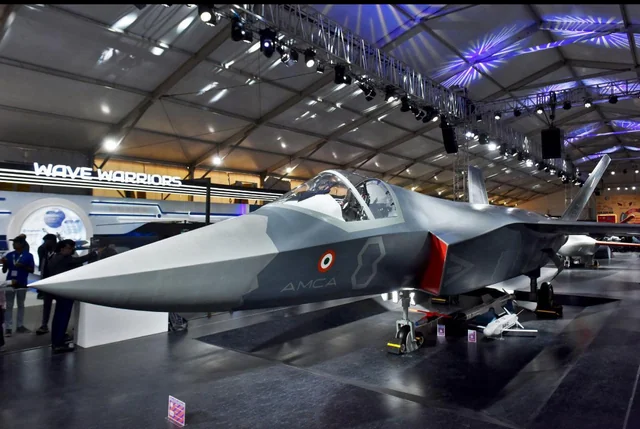

NEW DELHI – The Indian government is reportedly close to approving a joint project between French aerospace company Safran S.A. and India’s Gas Turbine Research Establishment (GTRE), a lab under the Defence Research and Development Organisation (DRDO), to co-develop a powerful jet engine. This will change India’s defense capabilities. This joint project, which came about after Prime Minister Narendra Modi called for the development of indigenous engines, is meant to power India’s Advanced Medium Combat Aircraft (AMCA), which has two engines.
Rajnath Singh, the Minister of Defense, has affirmed that India is ready to start this important project. The big plan calls for making nine engine prototypes over the course of 12 years. The engines will start off making 120 Kilo Newton (kN) of thrust, and the intention is to increase that to 140 kN by the end of the development schedule.
The full transfer of technology from Safran to DRDO is a major facet of this agreement, which is different from earlier deals with other countries. The deal is claimed to include important technologies, including crystal blade technology, which is necessary for making aircraft engines that work well. These blades are built of single-crystal super alloys and are meant to handle very high temperatures and stress. This is something that India’s earlier attempts, like the Kaveri engine, had trouble with.
The Modi government worked hard to speed up a plan that has been under review for the past two years, which led to the deal. The AMCA, a fifth-generation fighter jet that is being developed with the help of major Indian private sector corporations like the Tata Group, L&T, and Adani Defence, would use engines with 120 to 140 kN of power. This partnership is a key part of the “Make in India” and “Aatmanirbhar Bharat” (self-reliant India) programs.
The alliance with France is very important. The U.S. has promised to give some technology for its GE-414 engine, but the offer is only for about 70% of the technology, and prior U.S. offers have been perceived as conditional. France, on the other hand, has been a reliable partner for a long time, even after India’s nuclear tests in 1998. India’s 36 Rafale aircraft already use the French company’s M-88 Snecma engine. India will be less dependent on other countries for its fighter jets and engines since it will be able to make a more powerful engine with France. This would greatly increase India’s strategic independence.
The new engine is also slated to power the Indian Navy’s twin-engine deck-based fighter. This would make sure that both the Air Force and Navy have a strong, domestically-supported propulsion system for their future frontline aircraft.