

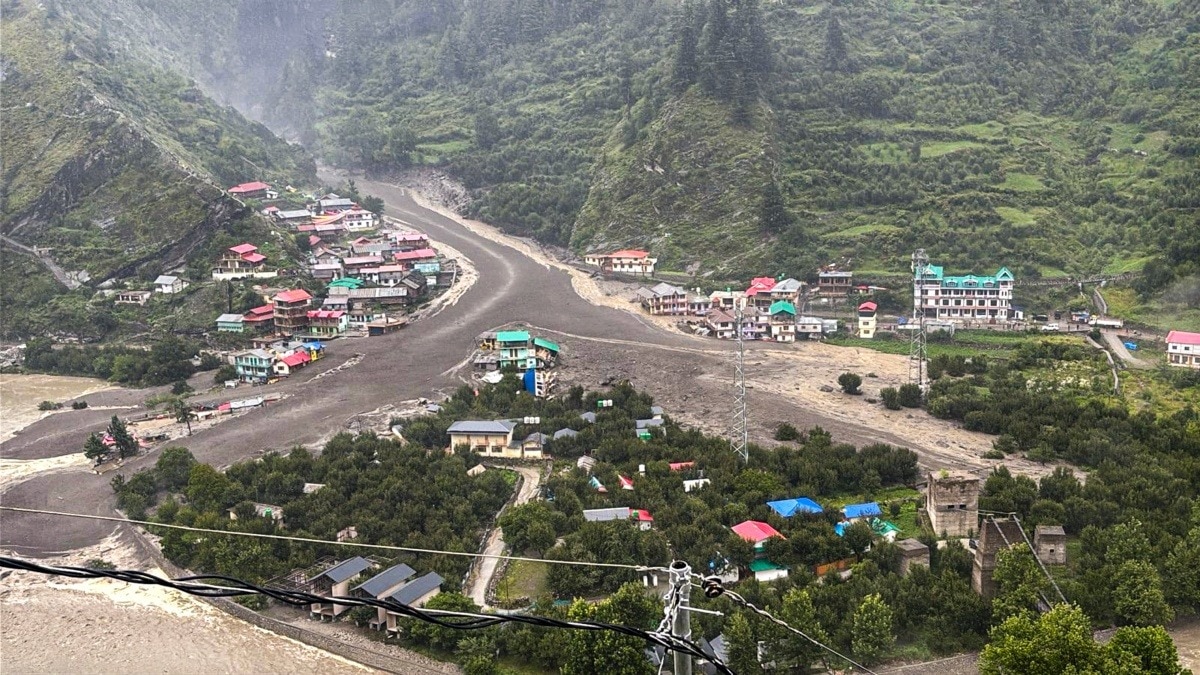

Two days after flash floods hit Uttarkashi, satellite photos showed how bad the damage was. The National Remote Sensing Centre took these pictures of Dharali hamlet, which is mostly covered in mud and debris. The thick sludge has buried whole buildings, roads, trees, and plantations. The strong flow of sediments that rushed down the Kheer Ganga river has also blocked a large part of the Bhagirathi river downstream, changing its course.
When you look at satellite photographs from June 13 and August 7, you can see a huge difference. A bridge and what look like orchards are entirely underwater. Experts think these pictures will be very helpful for the government and experts to figure out how bad the disaster was and what caused it.
The Glacier Collapse Theory is gaining support.
At first, people thought that a cloudburst caused the disaster, but a new idea based on satellite data and expert analysis is becoming more popular. Now, experts from places like the Indian Institute of Science’s Divecha Center for Climate Change and the National Disaster Management Authority (NDMA) are saying that a glacier collapse or a glacier Lake Outburst Flood (GLOF) may have been the underlying reason.
Anil Kulkarni, a prominent visiting scientist at the Divecha Center, examined satellite imagery of the Kheer Ganga river basin. He pointed out that the pictures show a “well-developed deglaciated valley” with traces of prior landslide activity from a moraine. This may have stopped the flow of meltwater and made a lake. A moraine is a pile of boulders and dirt that a glacier carries down and drops off. Kulkarni says that the “flash flood mud flow may have happened because the lake burst.”
Safi Ahsan Rizvi, an NDMA advisor, said more about it, saying that “there are signs that a glacial snout at 6,700m detached some days ago.” He said that this occurrence caused a lot of “glacio-fluvial debris deposits” to form. When it rained all the time, these deposits became loose and flowed down the river. “Once the critical mass was reached, the huge pile of debris fell downstream with the water in the Kheer Ganga, speeding up because of the steep slope,” Rizvi said.
Rizvi also made it clear that none of the 195 glacial lakes that the NDMA said were “at risk” are in the Dharali watershed. This suggests that the collapse may have occurred from a glacial formation that was unstable and not reported. The NDMA is hoping for sharper satellite images so that they can study the glacier that feeds the Kheer Ganga river more closely.
This event is similar to the Chamoli disaster in 2021, when a rock and ice avalanche caused floods that killed more than 200 people. Geologists and climate scientists are more and more worried about how the Himalayan ecosystem is becoming more fragile because of rising temperatures and unrestrained building in areas that are sensitive to geology.