

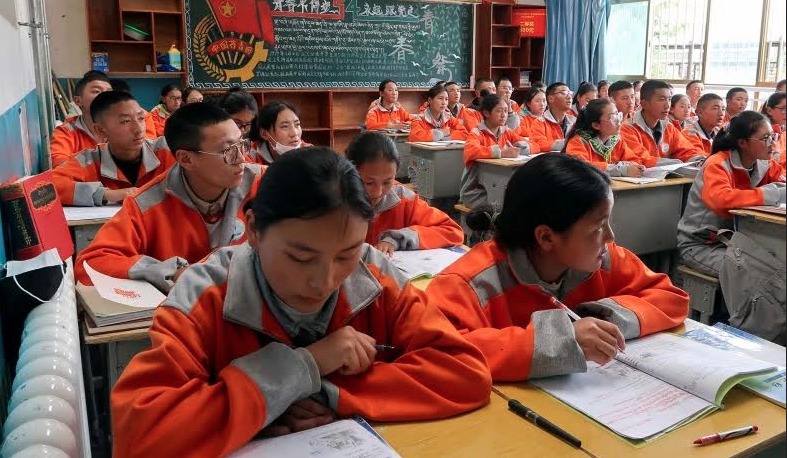

A newly released 62-page report by the US-based Tibet Action Institute has shed light on a disturbing trend: China’s growing use of colonial-style boarding schools across Tibet to politically assimilate Tibetan children, beginning as young as four years old. The report charges the Chinese Communist Party (CCP) with executing a systematic campaign to erase Tibetan cultural identity under the guise of education reform.
Assimilation Masquerading as Education
According to the report, over one lakh (100,000) children aged 4 to 6 are currently held in boarding preschools across Tibet, where:
- Tibetan language is banned
- Religious and cultural practices are prohibited, even during holidays
- Instruction is entirely in Chinese
- Children are forcibly separated from their families, despite being geographically close to their homes
More than 900,000 children aged 6–18 are already enrolled in similar institutions throughout the Tibetan region.
Condemnation from the Tibetan Diaspora
Members of the Tibetan parliament-in-exile and activists have strongly condemned what they are calling a cultural genocide.
Namgyal Dolkar, member of the Tibetan Parliament-in-Exile, told media:
“This is a categorically planned move by the CCP to control the minds and futures of Tibetans… The school system has been weaponized to destroy the Tibetan identity and forcibly mold children into believing they are nothing but a small fragment of Chinese identity.”
She also criticized China’s hypocrisy:
“China has signed and ratified key international treaties that mandate protection of children and minority languages, and even their own constitution guarantees such rights. Yet, these are blatantly violated.”
“Genocide in Literal Terms”
Tibetan activist Tenzin Tsundue labeled the practice a direct cultural genocide, stating:
“Children who live just minutes away from home are not allowed to return to their families. They are forced into compulsory boarding, learning only in Chinese. In 10–15 years, these children might grow up knowing only Mandarin, losing all ties to Tibetan language, culture, and heritage.”
A Broader CCP Agenda
The report links this educational policy to China’s broader strategy of ideological control, with clear parallels drawn to the CCP’s actions in Xinjiang and Inner Mongolia. The use of “bilingual education” — which in practice often means Mandarin-only instruction — has been in place since 2009 in some regions and was expanded aggressively post-2012.
Namgyal Dolkar emphasized:
“Tibetan children raised in the embrace of their families grow up pro-Tibet — that’s a threat to the Chinese Communist Party. Hence, this school model is enforced with political motivation.”
Global Appeal for Justice
The Tibetan exile community is now urging the international community to take action. Their demands include:
- Condemning China’s colonial school system
- Demanding closure of coercive boarding schools
- Holding China accountable under international human rights law
- Encouraging global governments to pressure Beijing via UN bodies and trade negotiations
Conclusion: A Race Against Time
With nearly a million children already affected, the Tibet Action Group’s report underscores that the survival of Tibetan culture is at a critical juncture. Activists warn that unless urgent international intervention occurs, a generation of Tibetans could grow up stripped of their language, culture, and identity, assimilated into a national narrative that denies their distinct heritage.
The world now faces a moral question: Will it speak out, or stay silent as an ancient culture is erased under the shadow of modern authoritarianism?