

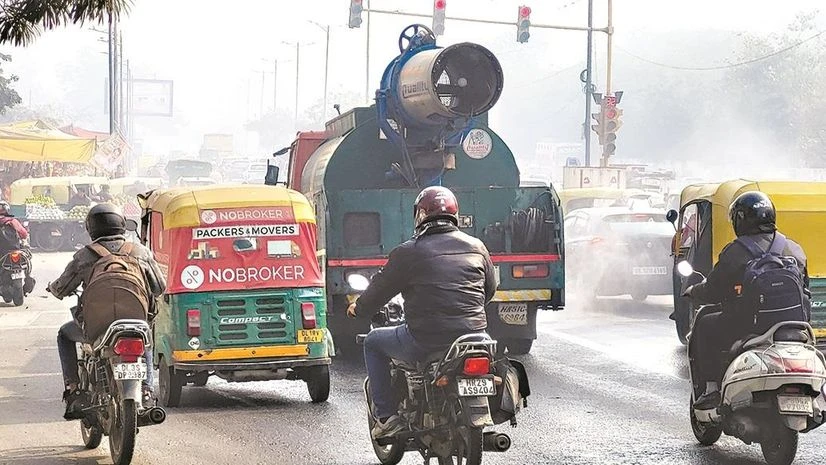

New Delhi: Nearly 44 per cent of Indian cities are grappling with chronic air pollution, driven by persistent emission sources rather than short-term episodes, according to an analysis by the Centre for Research on Energy and Clean Air (CREA). Alarmingly, only 4 per cent of these cities are currently included under the National Clean Air Programme (NCAP).
Using satellite data, CREA assessed PM2.5 levels in 4,041 Indian cities. The analysis revealed that 1,787 cities exceeded the national annual PM2.5 standard consistently over five recent years (excluding 2020). This indicates a structural air quality problem requiring targeted interventions.
The report highlights the most polluted cities of 2025: Byrnihat (100 µg/m³), Delhi (96 µg/m³), and Ghaziabad (93 µg/m³), followed by Noida, Gurugram, Greater Noida, Bhiwadi, Hajipur, Muzaffarnagar, and Hapur.
Despite the widespread pollution, India’s flagship NCAP covers only 130 cities, of which only 67 overlap with the 1,787 chronically polluted cities. This leaves the majority of affected urban areas outside the programme’s targeted clean air actions.
Uttar Pradesh tops the list with 416 non-attainment cities, followed by Rajasthan, Gujarat, Madhya Pradesh, Punjab, Bihar, and West Bengal. Among NCAP cities, monitoring gaps persist: 28 cities lack continuous ambient air quality monitoring stations, and 100 out of 102 cities with stations reported PM10 levels exceeding 80% of permissible limits.
Progress on PM10 reduction has been mixed:
- 23 cities achieved the revised 40% reduction target
- 28 cities recorded 21-40% reduction
- 26 cities showed modest improvements of 1-20%
- 23 cities saw increases in PM10 levels since NCAP’s inception
Delhi leads PM10 pollution with 197 µg/m³, followed by Ghaziabad (190 µg/m³) and Greater Noida (188 µg/m³). Rajasthan has the highest number of cities in the Top 50 for PM10 concentration (18 cities), followed by Uttar Pradesh, Madhya Pradesh, Bihar, and Odisha.
Manoj Kumar, India Analyst at CREA, emphasized that strengthening air quality governance through targeted, science-based reforms is crucial. Recommendations include prioritizing PM2.5 and precursor gases, revising non-attainment city lists, stricter emission standards for industries and power plants, allocating funding based on source apportionment, and adopting an airshed-based regional approach.
Since NCAP’s launch, ₹13,415 crore has been released under NC and 15th Finance Commission grants, with ₹9,929 crore utilized. The bulk of spending (68%) has gone to road dust management, followed by transport, waste, and biomass burning, while industries, domestic fuel use, public outreach, and capacity building received limited allocations.